# load packages
library(tidyverse)
library(tidymodels)
library(openintro)
library(knitr)
library(kableExtra)  # for table embellishments
library(Stat2Data)   # for empirical logit

# set default theme and larger font size for ggplot2
ggplot2::theme_set(ggplot2::theme_bw(base_size = 20))Logistic regression
Model selection
Announcements
Lab 06 due TODAY at 11:59pm
HW 04 due March 31 at 11:59pm
Statistics experience due April 15
SSMU Data Mini #3 - April 4
- See Ed Discussion for full announcement
Computational setup
Review from HW 03
Recall the four candidate models for Buchanan vs. Bush in HW 03:
| Model | Response variable | Predictor variable | RMSE |
|---|---|---|---|
| 1 | Buchanan2000 | Bush2000 | 348.6 |
| 2 | log(Buchanan2000) | Bush2000 | 0.758 |
| 3 | Buchanan2000 | log(Bush2000) | 369.533 |
| 4 | log(Buchanan2000) | log(Bush2000) | 0.460 |
Why is it unreliable to use these values of RMSE to choose the best fit model?
Topics
Comparing logistic regression models using
Drop-in-deviance test
AIC
BIC
Cross validation for logistic regression
Data: Risk of coronary heart disease
This data set is from an ongoing cardiovascular study on residents of the town of Framingham, Massachusetts. We want to examine the relationship between various health characteristics and the risk of having heart disease.
high_risk:- 1: High risk of having heart disease in next 10 years
- 0: Not high risk of having heart disease in next 10 years
age: Age at exam time (in years)education: 1 = Some High School, 2 = High School or GED, 3 = Some College or Vocational School, 4 = CollegecurrentSmoker: 0 = nonsmoker, 1 = smokertotChol: Total cholesterol (in mg/dL)
Data
# A tibble: 4,086 × 6
     age education TenYearCHD totChol currentSmoker high_risk
   <dbl> <fct>          <dbl>   <dbl> <fct>         <fct>
 1    39 4                  0     195 0             0
 2    46 2                  0     250 0             0
 3    48 1                  0     245 1             0
 4    61 3                  1     225 1             1
 5    46 3                  0     285 1             0
 6    43 2                  0     228 0             0
 7    63 1                  1     205 0             1
 8    45 2                  0     313 1             0
 9    52 1                  0     260 0             0
10    43 1                  0     225 1             0
# ℹ 4,076 more rows
Modeling risk of coronary heart disease
Using age, totChol, and currentSmoker
| term | estimate | std.error | statistic | p.value | conf.low | conf.high |
|---|---|---|---|---|---|---|
| (Intercept) | -6.673 | 0.378 | -17.647 | 0.000 | -7.423 | -5.940 |
| age | 0.082 | 0.006 | 14.344 | 0.000 | 0.071 | 0.094 |
| totChol | 0.002 | 0.001 | 1.940 | 0.052 | 0.000 | 0.004 |
| currentSmoker1 | 0.443 | 0.094 | 4.733 | 0.000 | 0.260 | 0.627 |
Review: ROC Curve + Model fit
high_risk_aug <- augment(high_risk_fit)

roc_curve_data <- high_risk_aug |>
  roc_curve(high_risk, .fitted, event_level = "second")

#calculate AUC
high_risk_aug |>
  roc_auc(high_risk, .fitted, event_level = "second")
# A tibble: 1 × 3
.metric .estimator .estimate
<chr> <chr> <dbl>
1 roc_auc binary 0.697Inference for coefficients
There are two approaches for testing coefficients in logistic regression
(Wald) hypothesis test: Use to test
- a single coefficient (when \(n\) is large)
Drop-in-deviance test: Use to test…
- a single coefficient
- a categorical predictor with 3+ levels
- a group of predictor variables
Drop-in-deviance test
Which model do we choose?
| term | estimate |
|---|---|
| (Intercept) | -6.673 |
| age | 0.082 |
| totChol | 0.002 |
| currentSmoker1 | 0.443 |
| term | estimate |
|---|---|
| (Intercept) | -6.456 |
| age | 0.080 |
| totChol | 0.002 |
| currentSmoker1 | 0.445 |
| education2 | -0.270 |
| education3 | -0.232 |
| education4 | -0.035 |
Log likelihood
\[ \begin{aligned} \log L = \sum\limits_{i=1}^n[y_i \log(\hat{\pi}_i) + (1 - y_i)\log(1 - \hat{\pi}_i)] \end{aligned} \]
. . .
Measure of how well the model fits the data
Higher values of \(\log L\) are better
Deviance = \(-2 \log L\)
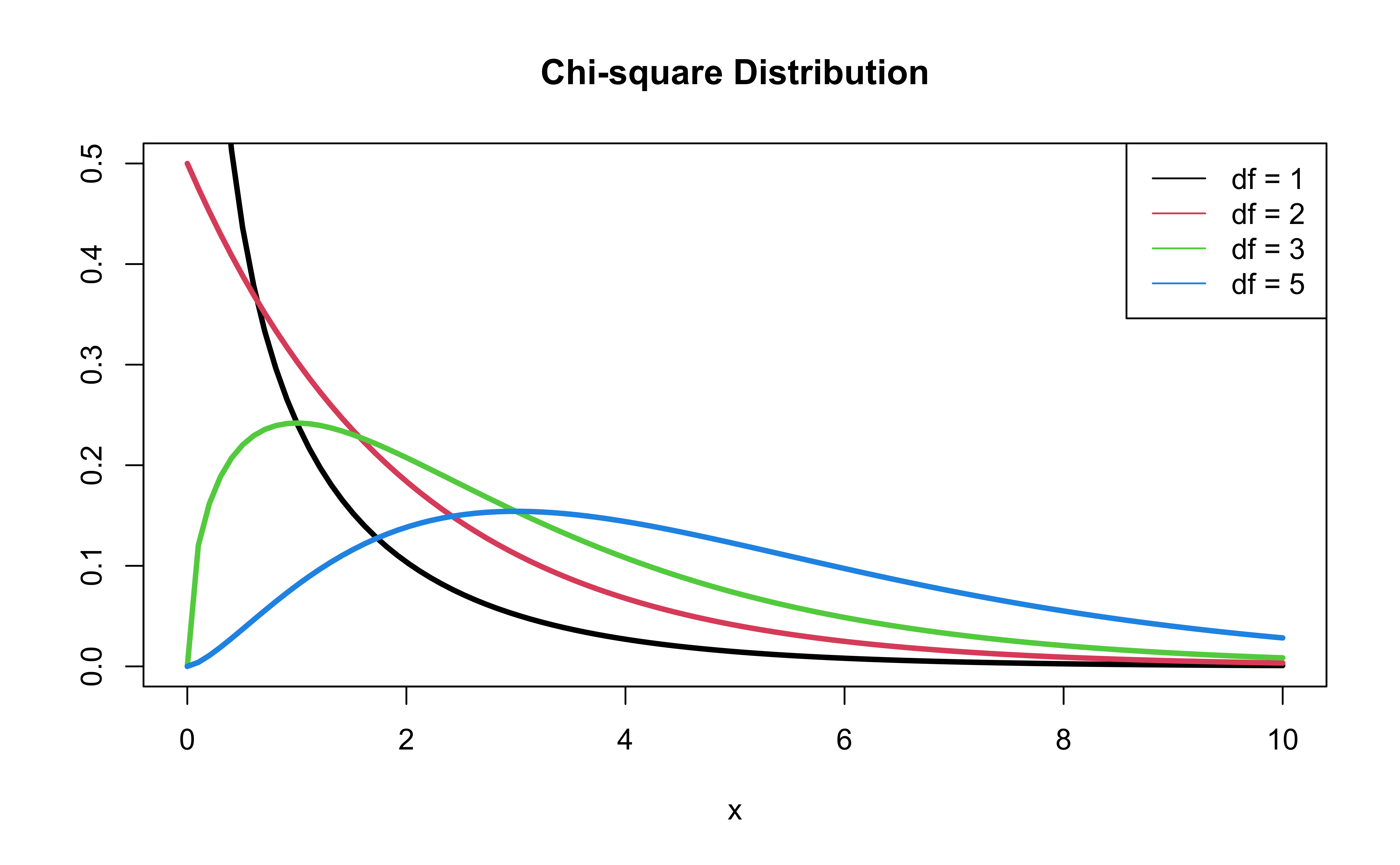
- \(-2 \log L\) follows a \(\chi^2\) (“Chi squared”) distribution with \(n - p - 1\) degrees of freedom
Comparing nested models
Suppose there are two nested models:
- Reduced Model includes predictors \(x_1, \ldots, x_q\)
- Full Model includes predictors \(x_1, \ldots, x_q, x_{q+1}, \ldots, x_p\)
We want to test the hypotheses
\[ \begin{aligned} H_0&: \beta_{q+1} = \dots = \beta_p = 0 \\ H_a&: \text{ at least one }\beta_j \text{ is not } 0 \end{aligned} \]
To do so, we will use the Drop-in-deviance test, also known as the Nested Likelihood Ratio test
Drop-in-deviance test
Hypotheses:
\[ \begin{aligned} H_0&: \beta_{q+1} = \dots = \beta_p = 0 \\ H_a&: \text{ at least one }\beta_j \text{ is not } 0 \end{aligned} \]
. . .
Test Statistic: \[\begin{aligned}G &= \text{Deviance}_{reduced} - \text{Deviance}_{full} \\ &= (-2 \log L_{reduced}) - (-2 \log L_{full})\end{aligned}\]
. . .
P-value: \(P(\chi^2 > G)\), calculated using a \(\chi^2\) distribution with degrees of freedom equal to the number of parameters being tested
\(\chi^2\) distribution
Add education to the model?
Reduced model
high_risk_fit_reduced <- glm(high_risk ~ age + totChol + currentSmoker,
                             data = heart_disease, family = "binomial")
. . .
Full model
Write the null and alternative hypotheses in words and mathematical notation.
Add education to the model?
Compute the deviance for each model:
(dev_reduced <- glance(high_risk_fit_reduced)$deviance)[1] 3224.812(dev_full <- glance(high_risk_fit_full)$deviance)[1] 3217.6. . .
Drop-in-deviance test statistic:
(test_stat <- dev_reduced - dev_full)[1] 7.212113Add education to the model?
Calculate the p-value using a pchisq(), with degrees of freedom equal to the number of new model terms in the second model:
pchisq(test_stat, 3, lower.tail = FALSE) [1] 0.06543567Add education to the model?
The p-value is 0.065. What is your conclusion?
Drop-in-Deviance test in R
- Use
anova()to conduct the drop-in deviance test
- Add argument
test = "Chisq"to conduct the drop-in-deviance test
. . .
anova(high_risk_fit_reduced, high_risk_fit_full, test = "Chisq") |>
tidy() |> kable(digits = 3)| term | df.residual | residual.deviance | df | deviance | p.value |
|---|---|---|---|---|---|
| high_risk ~ age + totChol + currentSmoker | 4082 | 3224.812 | NA | NA | NA |
| high_risk ~ age + totChol + currentSmoker + education | 4079 | 3217.600 | 3 | 7.212 | 0.065 |
Applies to linear regression
We can use the drop-in-deviance test to test for subset of predictors in linear regression
The deviance for the linear regression model is the sum of squared residuals
\[ SSR = \sum_{i=1}^n(y_i - \hat{y}_i)^2 \]
The test statistic for the drop-in-deviance test is \[G = SSR_{\text{reduced}} - SSR_{full}\]
This is also called the Nested F Test
Model selection using AIC and BIC
AIC & BIC
Estimators of prediction error and relative quality of models:
. . .
Akaike’s Information Criterion (AIC)1: \[AIC = -2\log L + 2(p+1)\]
. . .
Bayesian Information Criterion (BIC)2: \[ BIC = -2\log L + \log(n)\times(p+1)\]
AIC & BIC
\[ \begin{aligned} & AIC = -2\log L \color{black}{+ 2(p+1)} \\ & BIC = -2\log L + \color{black}{\log(n)\times(p+1)} \end{aligned} \]
where \(\log L\) is the log-likelihood evaluated at the maximum likelihood estimate, \((p+1)\) is the number of terms in the model, and \(n\) is the sample size
AIC & BIC
\[ \begin{aligned} & AIC = -2\log L \color{black}{+ 2(p+1)} \\ & BIC = -2\log L + \color{black}{\log(n)\times(p+1)} \end{aligned} \]
. . .
First Term: Decreases as p increases (assuming “step-wise” model selection approach)
Second term: Increases as p increases
If \(n \geq 8\), the penalty for BIC is larger than that of AIC, so BIC tends to favor more parsimonious models (i.e. models with fewer terms)
AIC from the glance() function
Let’s look at the AIC for the model that includes age, totChol, and currentSmoker
glance(high_risk_fit)$AIC[1] 3232.812. . .
Calculating AIC
- 2 * glance(high_risk_fit)$logLik + 2 * (3 + 1)[1] 3232.812Comparing the models using AIC
Let’s compare the reduced and full models using AIC.
## AIC reduced model
glance(high_risk_fit_reduced)$AIC
[1] 3232.812## AIC full model
glance(high_risk_fit_full)$AIC[1] 3231.6Based on AIC, which model would you choose?
Comparing the models using BIC
Let’s compare the reduced and full models using BIC
## BIC reduced model
glance(high_risk_fit_reduced)$BIC
[1] 3258.074## BIC full model
glance(high_risk_fit_full)$BIC[1] 3275.807Based on BIC, which model would you choose?
Application exercise
Cross validation for logistic regression
Footnotes
Akaike, Hirotugu. “A new look at the statistical model identification.” IEEE transactions on automatic control 19.6 (1974): 716-723.↩︎
Schwarz, Gideon. “Estimating the dimension of a model.” The annals of statistics (1978): 461-464.↩︎