Model conditions + diagnostics

Prof. Maria Tackett

Feb 10, 2026

Announcements

  • HW 02 due TODAY at 11:59pm

  • Lab 03 due Thursday, February 12 at 11:59pm

Exam 01 resources

Computing set up

# load packages
library(tidyverse)  
library(tidymodels)  
library(knitr)       
library(patchwork)   
library(viridis)

# set default theme in ggplot2
ggplot2::theme_set(ggplot2::theme_bw())

Topics

  • Review AE 06

  • Model conditions

  • Influential points

  • Model diagnostics

    • Leverage

    • Studentized residuals

    • Cook’s Distance

Review: AE 06

Permutation sampling in MLR

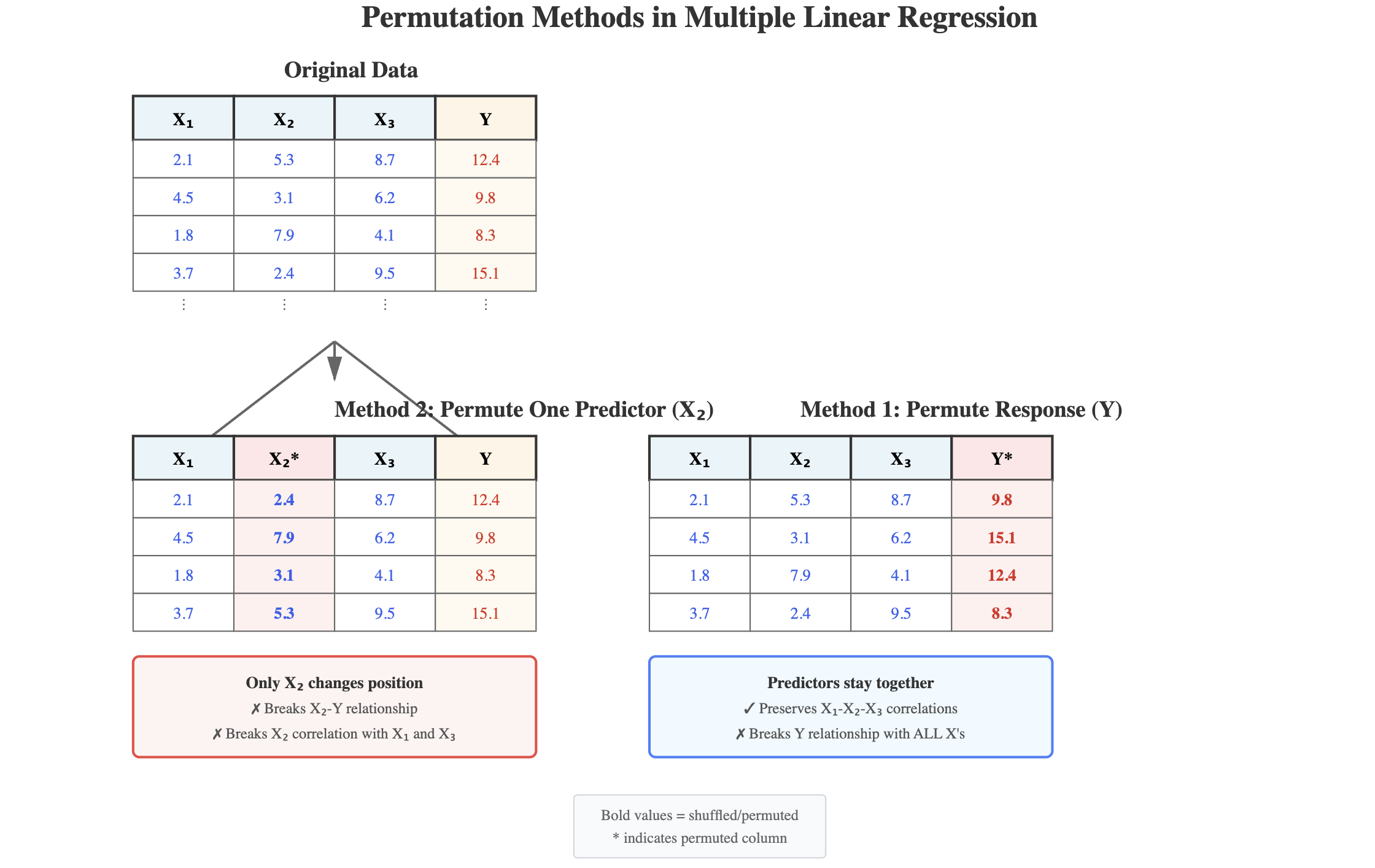
In the last lecture, we talked about two different ways to permute data when conducting a permutation test for multiple linear regression. Choose the response that best describes how the structure of the data is changed with each method.

🔗 https://forms.office.com/r/LBXenrfGJw

Permutation illustrated

Generate from Claude AI Sonnet 4.5 using the prompt: “Please draw a picture illustrating permuting the response variable versus permuting individual predictor variables.”

Data: Duke lemurs

Today’s data contains a subset of the original Duke Lemur data set available in the TidyTuesday GitHub repo. This data includes information on lemurs age 25 months or young from who were at the Duke Lemur Center when they were measured.

The goal of the analysis is to use the age, sex, taxon, and litter size of the lemurs to understand variability in the weight.

Rows: 252 Columns: 8
── Column specification ────────────────────────────────────────────────────────
Delimiter: ","
chr  (3): name, sex, taxon
dbl  (4): dlc_id, litter_size, age, weight
date (1): dob

ℹ Use `spec()` to retrieve the full column specification for this data.
ℹ Specify the column types or set `show_col_types = FALSE` to quiet this message.

Variables

  • weight: Weight: Animal weight, in grams. Weights under 500g generally to nearest 0.1-1g; Weights >500g generally to the nearest 1-20g.

  • sex : Sex of lemur (M: Male, F: Female)

  • age: Age of lemur when weight was recorded (in months)

  • litter_size: Total number of infants in the litter the lemur was born into (this includes the observed lemur)

Variables

  • taxon : Code made as a combination of the lemur’s genus and species. Note that the genus is a broader categorization that includes lemurs from multiple species. This analysis focuses on the following taxon:

    • ERUF: Eulemur rufus, commonly known as Red-fronted brown lemur
    • PCOQ: Propithecus coquereli, commonly known as Coquerel’s sifaka
    • VRUB: Varecia rubra, commonly known as Red ruffed lemur

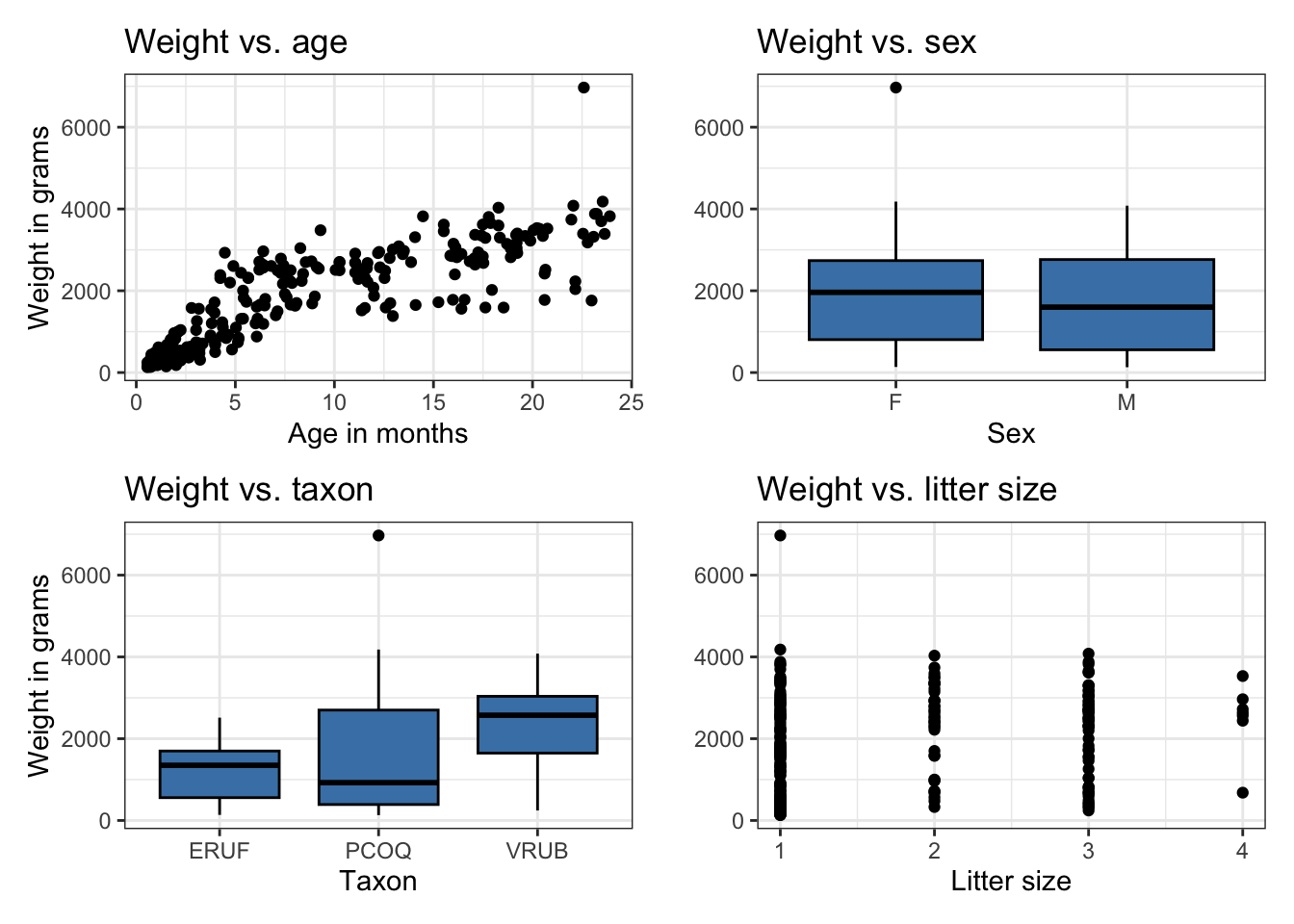
Bivariate EDA

Fit model

lemurs_fit <- lm(weight ~ age + sex + taxon + litter_size, data = lemurs)

tidy(lemurs_fit) |> 
  kable(digits = 3)
term estimate std.error statistic p.value
(Intercept) 43.844 121.715 0.360 0.719
age 136.903 4.858 28.182 0.000
sexM -88.838 68.001 -1.306 0.193
taxonPCOQ 471.715 95.430 4.943 0.000
taxonVRUB 1037.323 133.906 7.747 0.000
litter_size -19.607 65.797 -0.298 0.766

Model conditions

Assumptions for regression

\[ Y|X_1, \ldots, X_p \sim N(\beta_0 + \beta_1X_1 + \dots + \beta_pX_p, \sigma_\epsilon^2) \]

  1. Linearity: There is a linear relationship between the response and predictor variables.
  2. Equal variance: The variability about the least squares line is equal for all combinations of predictors.
  3. Normality: The distribution of the errors (residuals) is approximately normal.
  4. Independence: The errors (residuals) are independent from one another.

How do we know if these assumptions hold in our data?

Linearity

  • Look at plot of residuals versus fitted (predicted) values.
  • Linearity is satisfied if there is no discernible pattern in the plot (i.e., points randomly scattered around \(\text{residuals} = 0\))
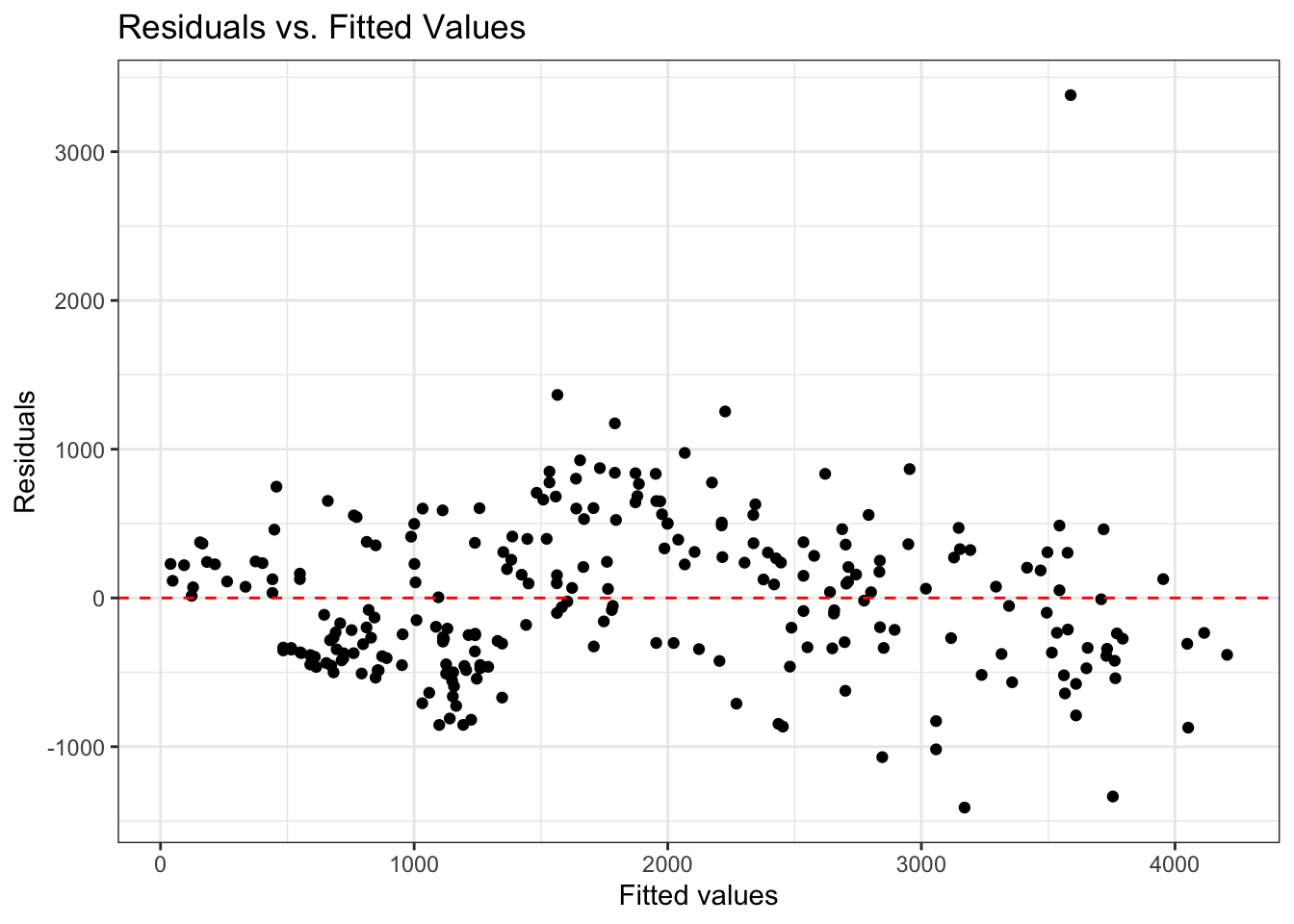
Linearity is satisfied

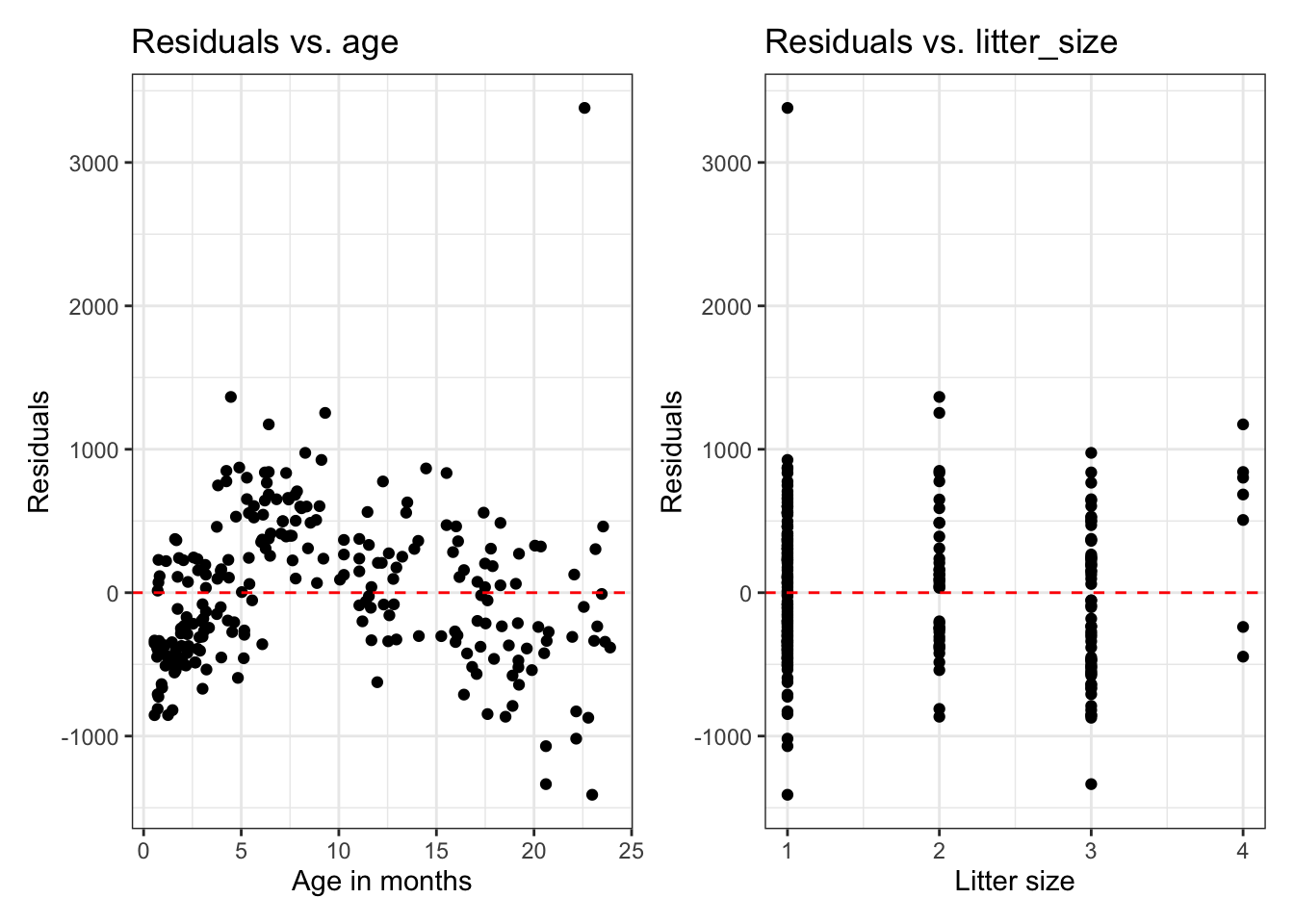
Residuals vs. predictors

If we need a closer look at the linearity condition, we can plot the residuals versus each quantitative predictor.
Example: Linearity not satisfied
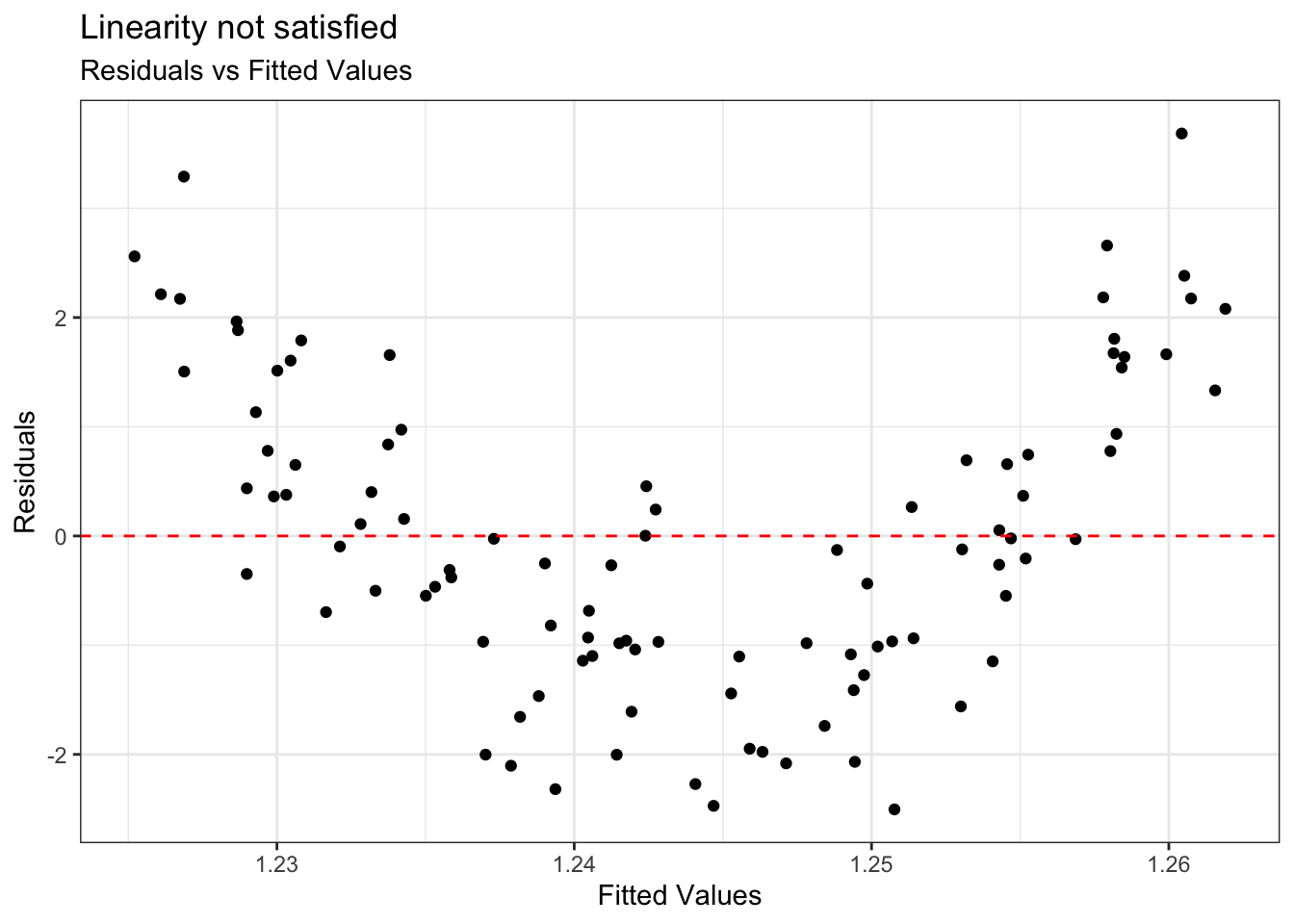
  • If linearity is not satisfied, examine the plots of residuals versus each predictor.
  • Add higher order term(s), as needed.

Equal variance

  • Look at plot of residuals versus fitted (predicted) values.
  • Equal variance is satisfied if the vertical spread of the points is approximately equal for all fitted values
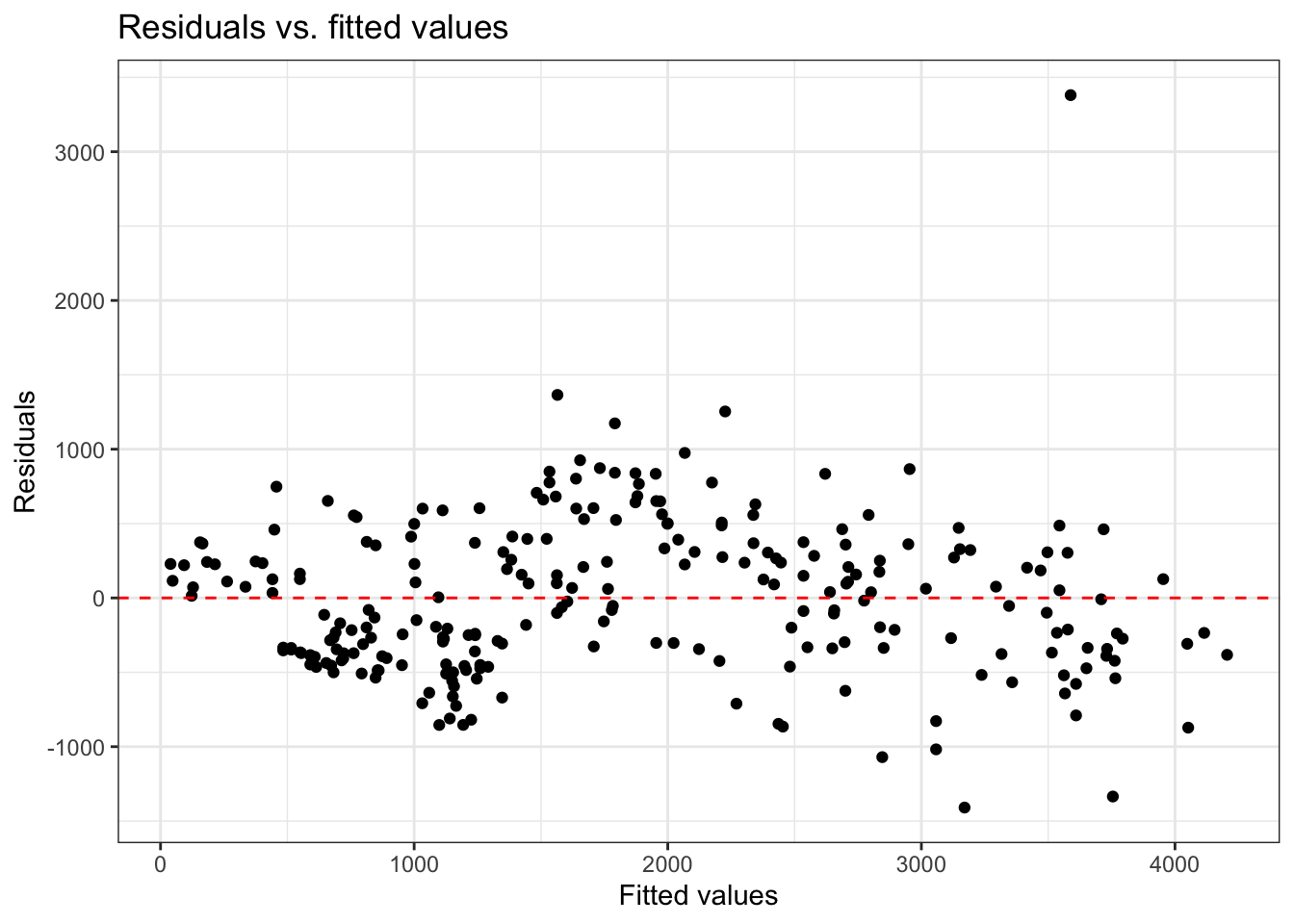
Equal variance is satisfied

Example: Equal variance not satisfied
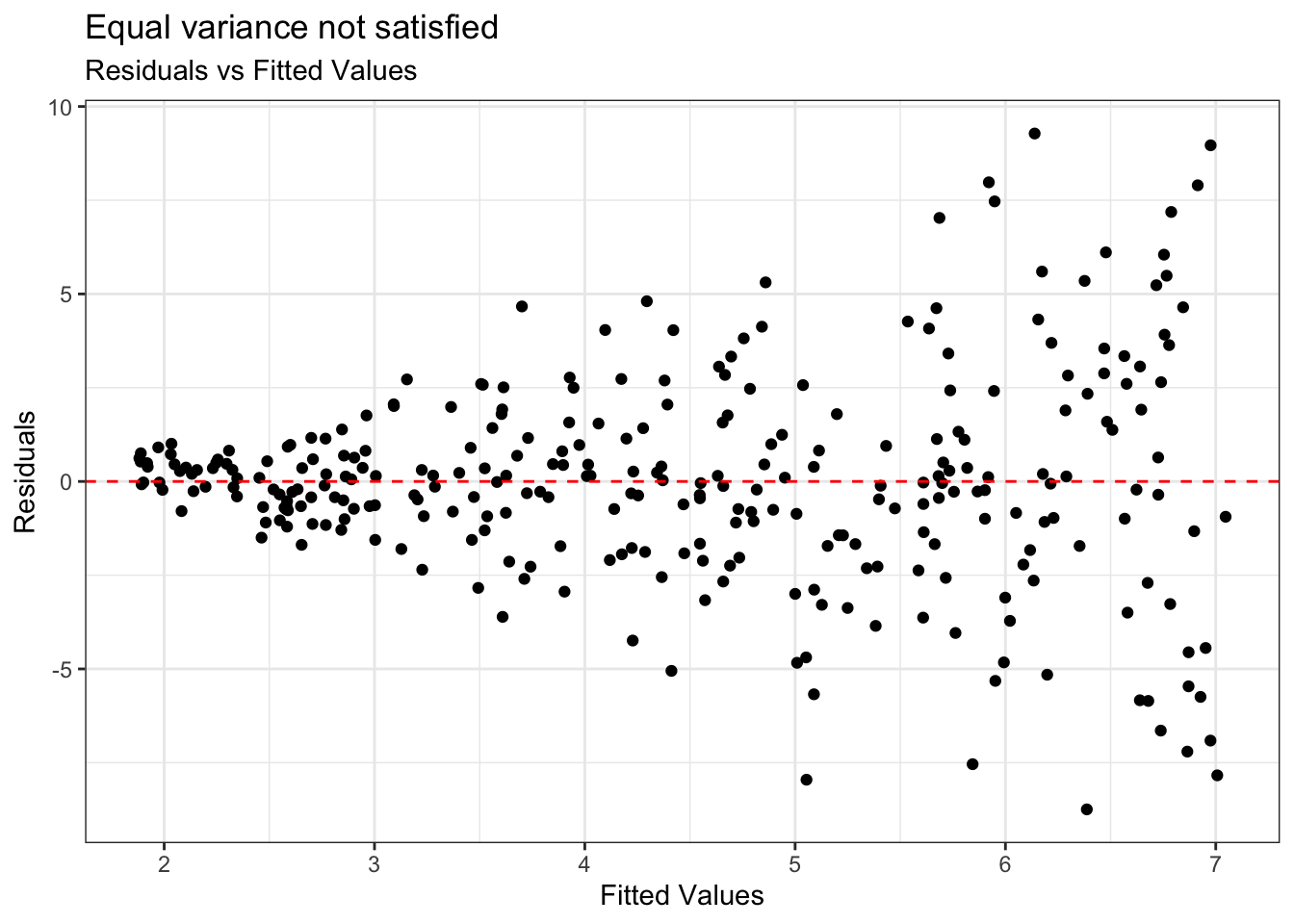
  • Condition is critical for inference

  • Address violations by applying transformation on the response

Normality

  • Look at the distribution of the residuals
  • Normality is satisfied if the distribution is approximately unimodal and symmetric. Inference robust to violations if \(n > 30\)
`stat_bin()` using `bins = 30`. Pick better value `binwidth`.
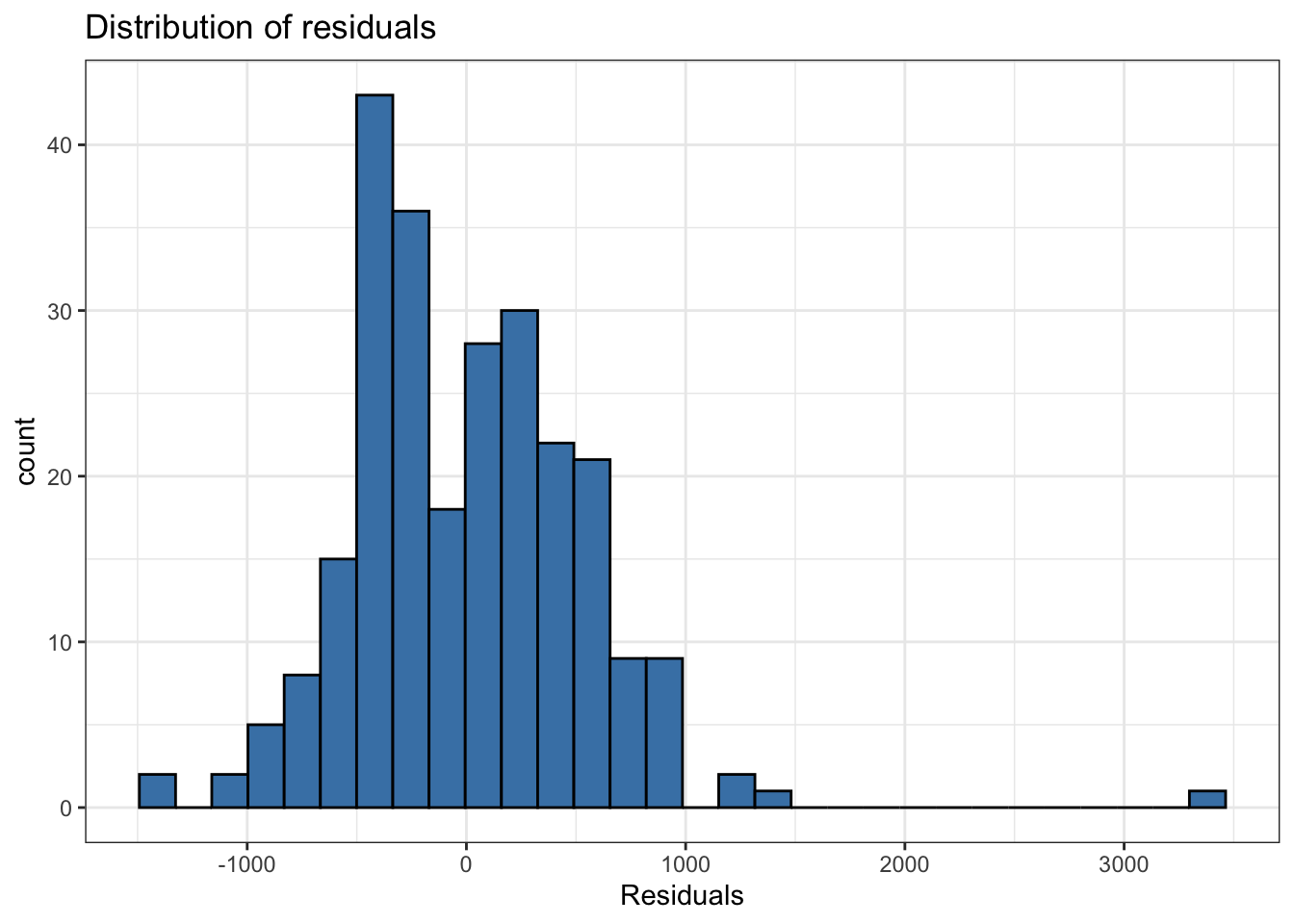
Distribution approximately unimodal and symmetric, aside from the outlier. There are 252 observations, so inference robust to departures from normality

Independence

  • We can often check the independence condition based on the context of the data and how the observations were collected.

  • If the data were collected in a particular order, examine a scatterplot of the residuals versus order in which the data were collected.

  • If data has spatial element, plot residuals on a map to examine potential spatial correlation.

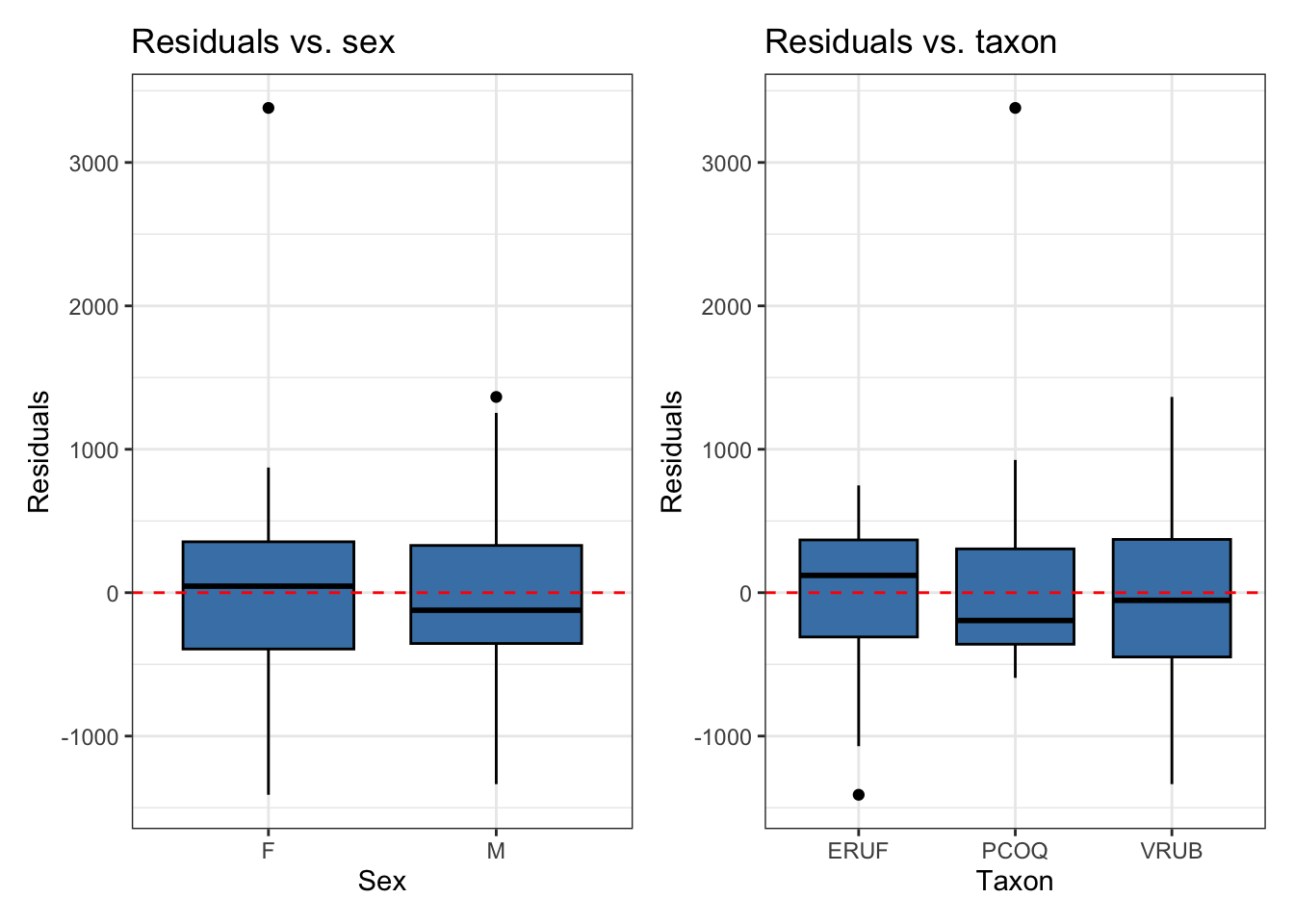
  • If there are subgroups in the data, plot the residuals by subgroup

Independence

The independence condition is satisfied.

What conditions are needed?

Model condition Interpret and predict Simulation-based inference Theory-based inference
Linearity Important Important Important
Independence Not needed Important Important
Normality Not needed Not needed

Not needed if \(n >> 30\)

Important if \(n < 30\)

Equal variance Not needed Not needed Important

Model diagnostics

Model diagnostics

lemurs_aug <- augment(lemurs_fit)

lemurs_aug |> slice(1:10)
# A tibble: 10 × 11
   weight   age sex   taxon litter_size .fitted .resid   .hat .sigma    .cooksd
    <dbl> <dbl> <chr> <chr>       <dbl>   <dbl>  <dbl>  <dbl>  <dbl>      <dbl>
 1    410  2.27 F     ERUF            1    335.   75.0 0.0277   534. 0.0000968 
 2    137  0.72 F     ERUF            1    123.   14.2 0.0298   534. 0.00000374
 3    206  0.69 F     PCOQ            1    590. -384.  0.0201   533. 0.00182   
 4    185  1.05 M     PCOQ            1    551. -366.  0.0183   533. 0.00150   
 5    373  2.66 F     PCOQ            1    860. -487.  0.0178   533. 0.00257   
 6    200  0.76 F     ERUF            1    128.   71.7 0.0297   534. 0.0000953 
 7   1861  9.01 F     ERUF            1   1258.  603.  0.0234   533. 0.00525   
 8   1634  8.02 M     ERUF            1   1033.  601.  0.0272   533. 0.00609   
 9    636  2.76 F     ERUF            1    402.  234.  0.0272   534. 0.000921  
10    373  1.74 F     ERUF            1    262.  111.  0.0284   534. 0.000216  
# ℹ 1 more variable: .std.resid <dbl>

Model diagnostics in R

Use the augment() function in the broom package to output the model diagnostics (along with the predicted values and residuals)

  • response and predictor variables in the model
  • .fitted: predicted values
  • .se.fit: standard errors of predicted values
  • .resid: residuals
  • .hat: leverage
  • .sigma: estimate of residual standard deviation when the corresponding observation is dropped from model
  • .cooksd: Cook’s distance
  • .std.resid: standardized residuals

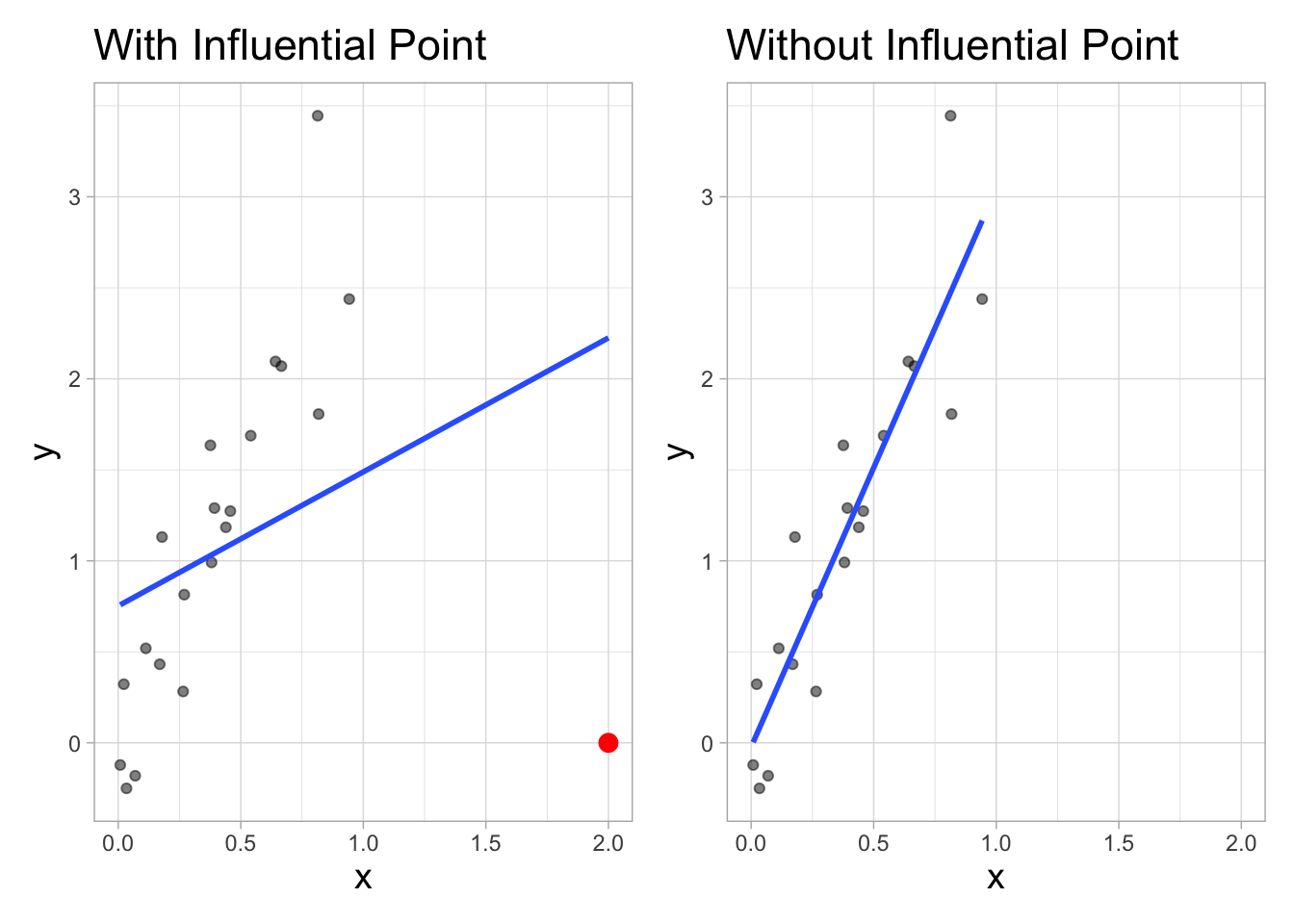
Influential Point

An observation is influential if removing has a noticeable impact on the regression coefficients

`geom_smooth()` using formula = 'y ~ x'
Influential points

  • Influential points have a noticeable impact on the coefficients and standard errors used for inference
  • These points can sometimes be identified in a scatterplot if there is only one predictor variable
    • This is often not the case when there are multiple predictors
  • We will use measures to quantify an individual observation’s influence on the regression model
    • leverage, standardized & studentized residuals, and Cook’s distance

Leverage

Leverage

  • Leverage \((h_i)\) : a measure of the distance of the predictor (or combination of predictors) for the \(i^{th}\) observation is from the mean value of the predictor (or combination of predictors)

  • For simple linear regression:

\[ h_i = \frac{1}{n} + \frac{(x_i - \bar{x})^2}{\sum_{j = 1}^n(x_j - \bar{x})^2} \]

  • Observations with large values of \(h_{i}\) are far away from the typical value (or combination of values) of the predictors in the data

Large leverage

  • The sum of the leverages for all points is \(p + 1\), where \(p\) is the number of predictors in the model

  • The average value of leverage is \(\bar{h} = \frac{(p+1)}{n}\)

  • An observation has large leverage if \[h_{i} > \frac{2(p+1)}{n}\]

Lemurs: Leverage

h_threshold <- 2 * (5 + 1) / nrow(lemurs)
h_threshold
[1] 0.04761905
lemurs_aug |>
  filter(.hat > h_threshold)
# A tibble: 13 × 11
   weight   age sex   taxon litter_size .fitted .resid   .hat .sigma  .cooksd
    <dbl> <dbl> <chr> <chr>       <dbl>   <dbl>  <dbl>  <dbl>  <dbl>    <dbl>
 1  2605   4.9  F     VRUB            1   1732.  873.  0.0563   531. 0.0282  
 2  2574  12.3  M     VRUB            1   2657.  -82.6 0.0503   534. 0.000224
 3  2502. 10.3  M     VRUB            1   2377.  124.  0.0502   534. 0.000503
 4  2076  12.0  F     VRUB            1   2700. -624.  0.0520   532. 0.0132  
 5  3532  20.2  F     VRUB            4   3771. -239.  0.0520   534. 0.00194 
 6  3804  17.8  F     VRUB            1   3497.  307.  0.0547   534. 0.00339 
 7  1589  18.5  M     ERUF            2   2454. -865.  0.0504   531. 0.0246  
 8  3010  13.0  F     VRUB            1   2834.  176.  0.0521   534. 0.00105 
 9  2550  11.6  F     VRUB            1   2655. -105.  0.0520   534. 0.000375
10   440   0.76 F     VRUB            1   1166. -726.  0.0626   532. 0.0220  
11   680   1.55 M     VRUB            4   1126. -446.  0.0485   533. 0.00625 
12  3820  14.5  M     VRUB            1   2954.  866.  0.0513   531. 0.0251  
13   617   1.12 M     VRUB            1   1126. -509.  0.0579   533. 0.00993 
# ℹ 1 more variable: .std.resid <dbl>

Let’s look at the data

`stat_bin()` using `bins = 30`. Pick better value `binwidth`.
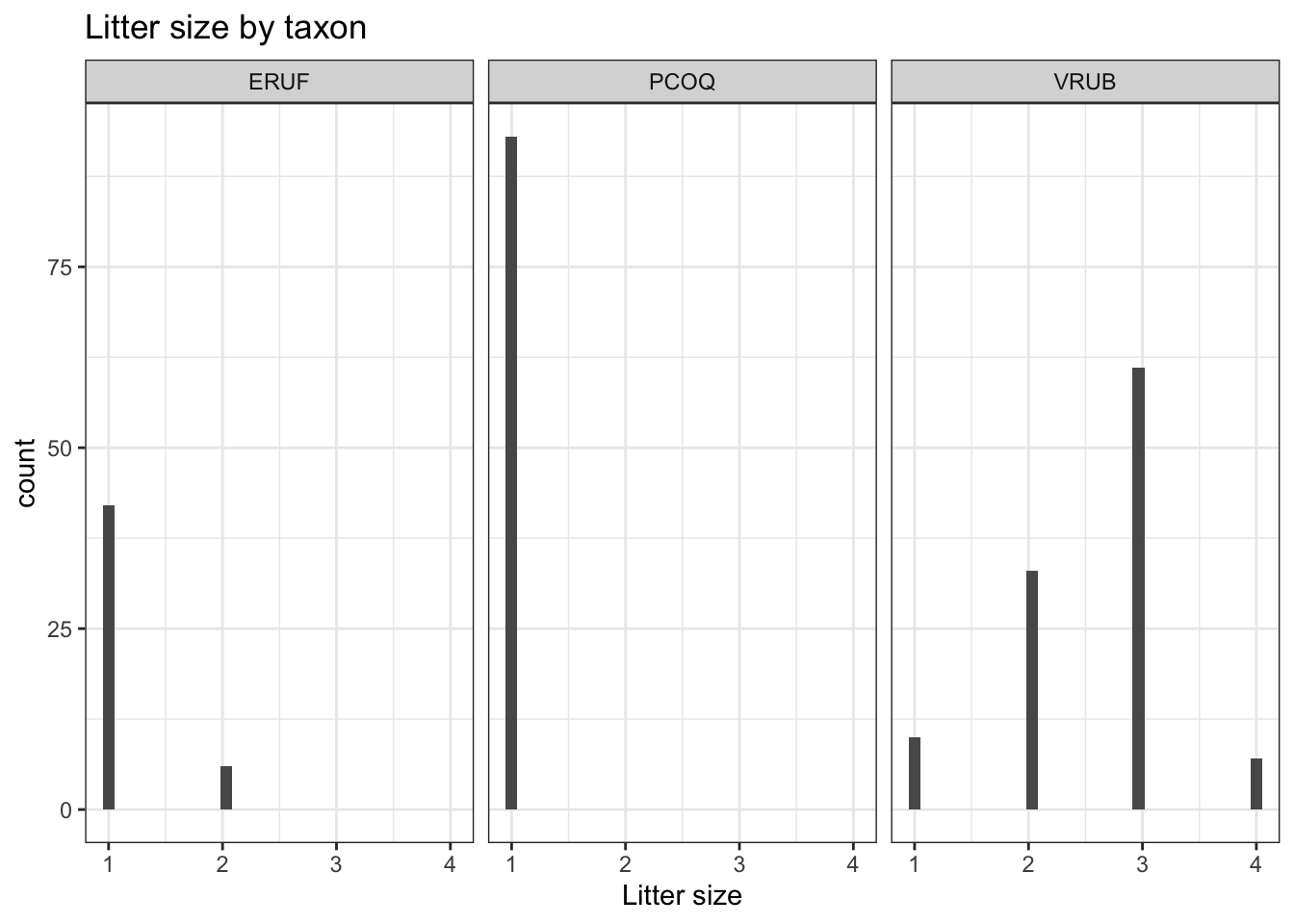
The high leverage points are primarily VRUB lemurs with no siblings.

Large leverage

If there is point with high leverage, ask

  • ❓ Is there a data entry error?

  • ❓ Is this observation within the scope of individuals for which you want to make predictions and draw conclusions?

  • ❓ Is this observation impacting the estimates of the model coefficients? (Need more information!)

Just because a point has high leverage does not necessarily mean it will have a substantial impact on the regression. Therefore we need to check other measures.

Scaled residuals

Scaled residuals

  • What is the best way to identify outlier points that don’t fit the pattern from the regression line?

    • Look for points that have large residuals
  • We can rescale residuals and put them on a common scale to more easily identify “large” residuals

  • We will consider two types of scaled residuals: standardized residuals and studentized residuals

Standardized residuals

  • The variance of the residuals can be estimated by the mean squared residuals (MSR) \(= \frac{SSR}{n - p - 1} = \hat{\sigma}^2_{\epsilon}\)

  • We can use MSR to compute standardized residuals

    \[ std.res_i = \frac{e_i}{\hat{\sigma}_{\epsilon}} \]

  • Standardized residuals are produced by augment() in the column .std.resid

Using standardized residuals

We can examine the standardized residuals directly from the output from the augment() function
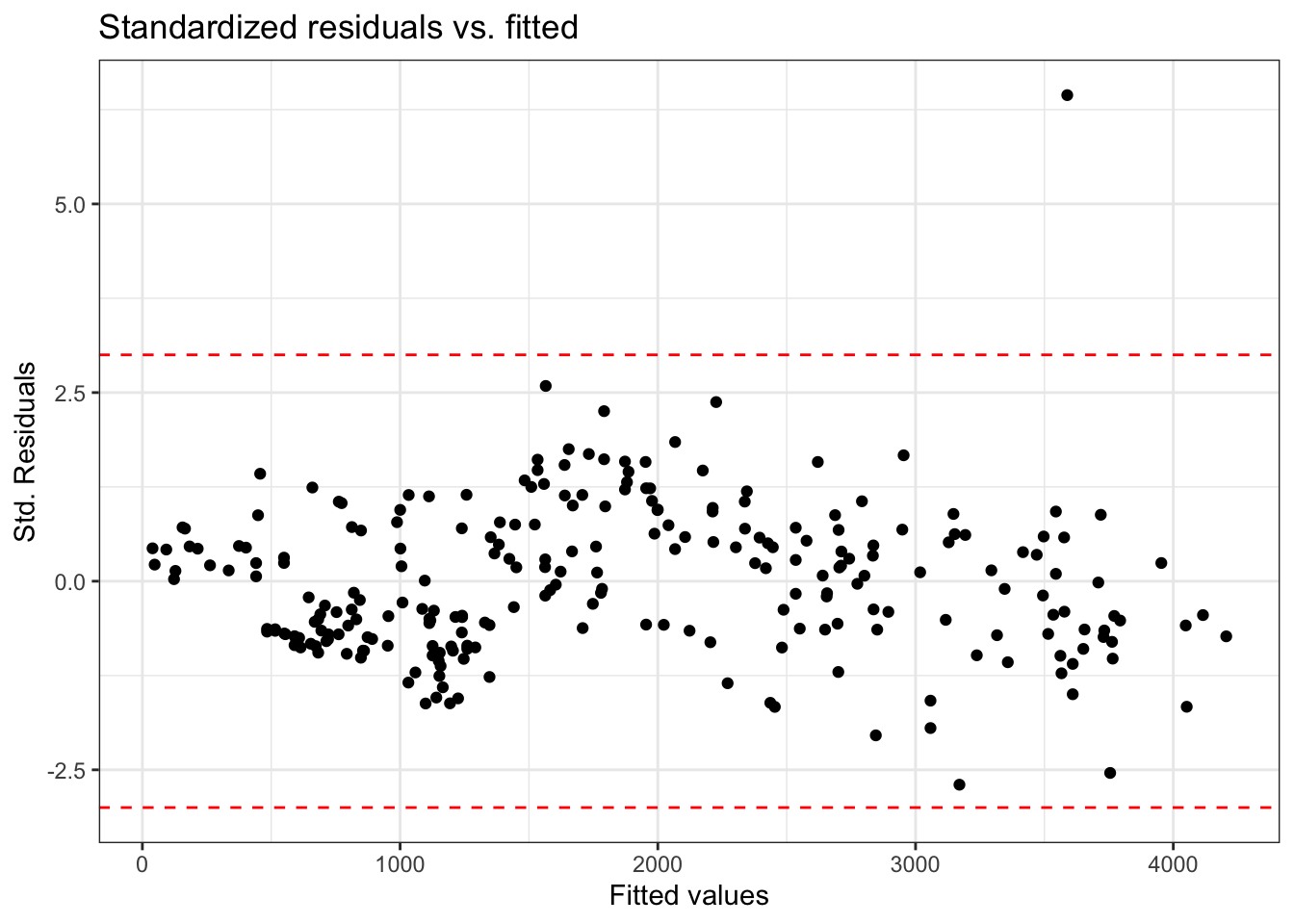
  • An observation is a potential outlier if its standardized residual is beyond \(\pm 3\)

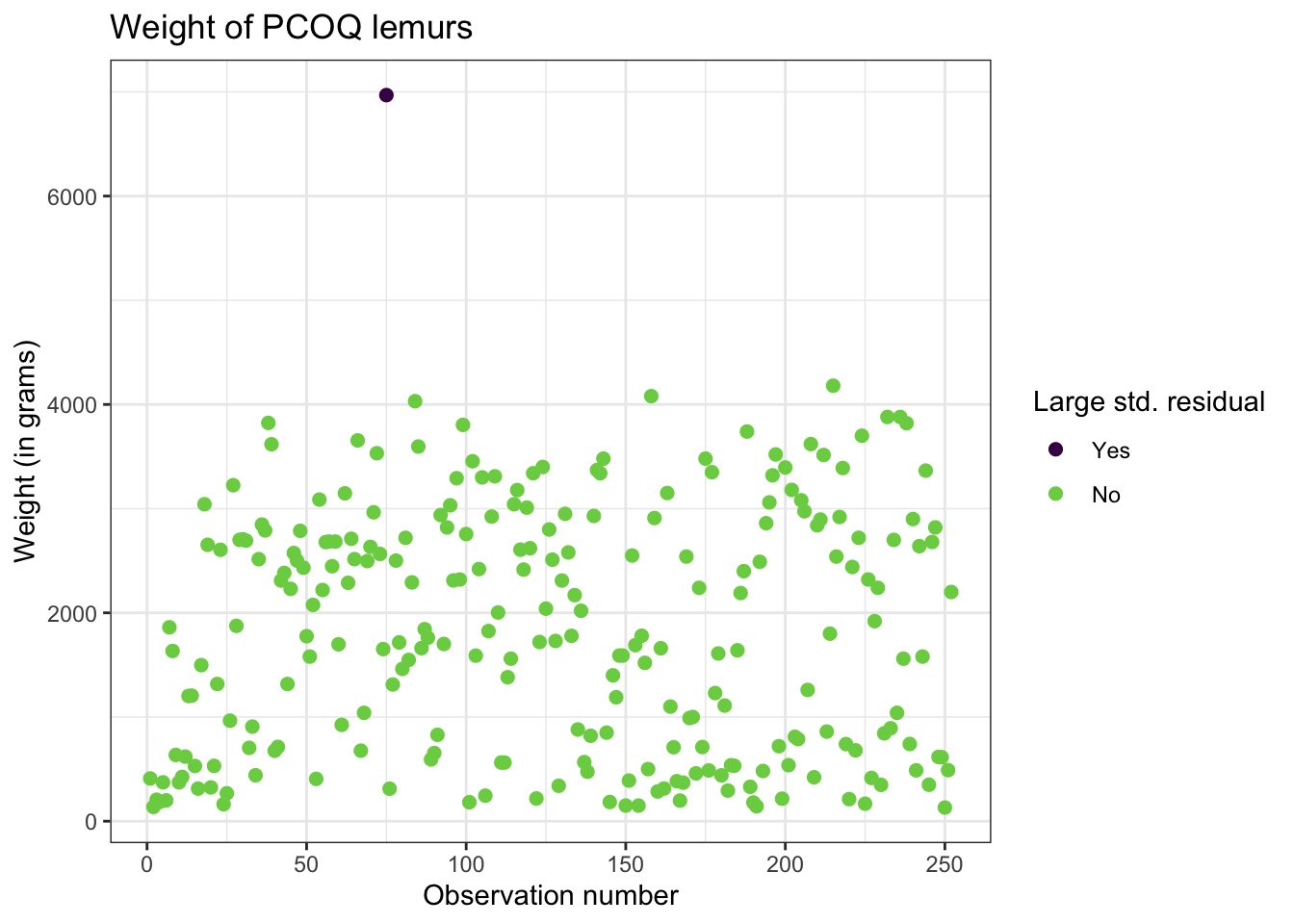
Digging in to the data

Let’s look at the value of the response variable to better understand potential outliers
Studentized residuals

  • MSR is an approximation of the variance of the residuals.

  • A more precise calculation of the variance for the \(i^{th}\) residual is is \(Var(e_i) = \hat{\sigma}^2_{\epsilon}(1 - h_{i})\)

    • This is called the studentized residual

\[ r_i = \frac{e_{i}}{\sqrt{\hat{\sigma}^2_{\epsilon}(1 - h_{i})}} \]

  • Standardized and studentized residuals provide similar information about which points are outliers in the response.
    • Studentized residuals are used to compute Cook’s Distance

Cook’s Distance

Motivating Cook’s Distance

  • An observation’s influence on the regression line depends on

    • How close it lies to the general trend of the data

    • Its leverage

  • Cook’s Distance is a statistic that includes both of these components to measure an observation’s overall impact on the model

Cook’s Distance

Cook’s distance for the \(i^{th}\) observation is

\[ D_i = \frac{r^2_i}{p + 1}\Big(\frac{h_{i}}{1 - h_{i}}\Big) \]

where \(r_i\) is the studentized residual and \(h_{i}\) is the leverage for the \(i^{th}\) observation

This measure is a combination of

  • How well the model fits the \(i^{th}\) observation (magnitude of residuals)

  • How far the combination of predictors for the \(i^{th}\) observation is from the rest of the observations

Using Cook’s Distance

  • An observation with large value of \(D_i\) is said to have a strong influence on the predicted values

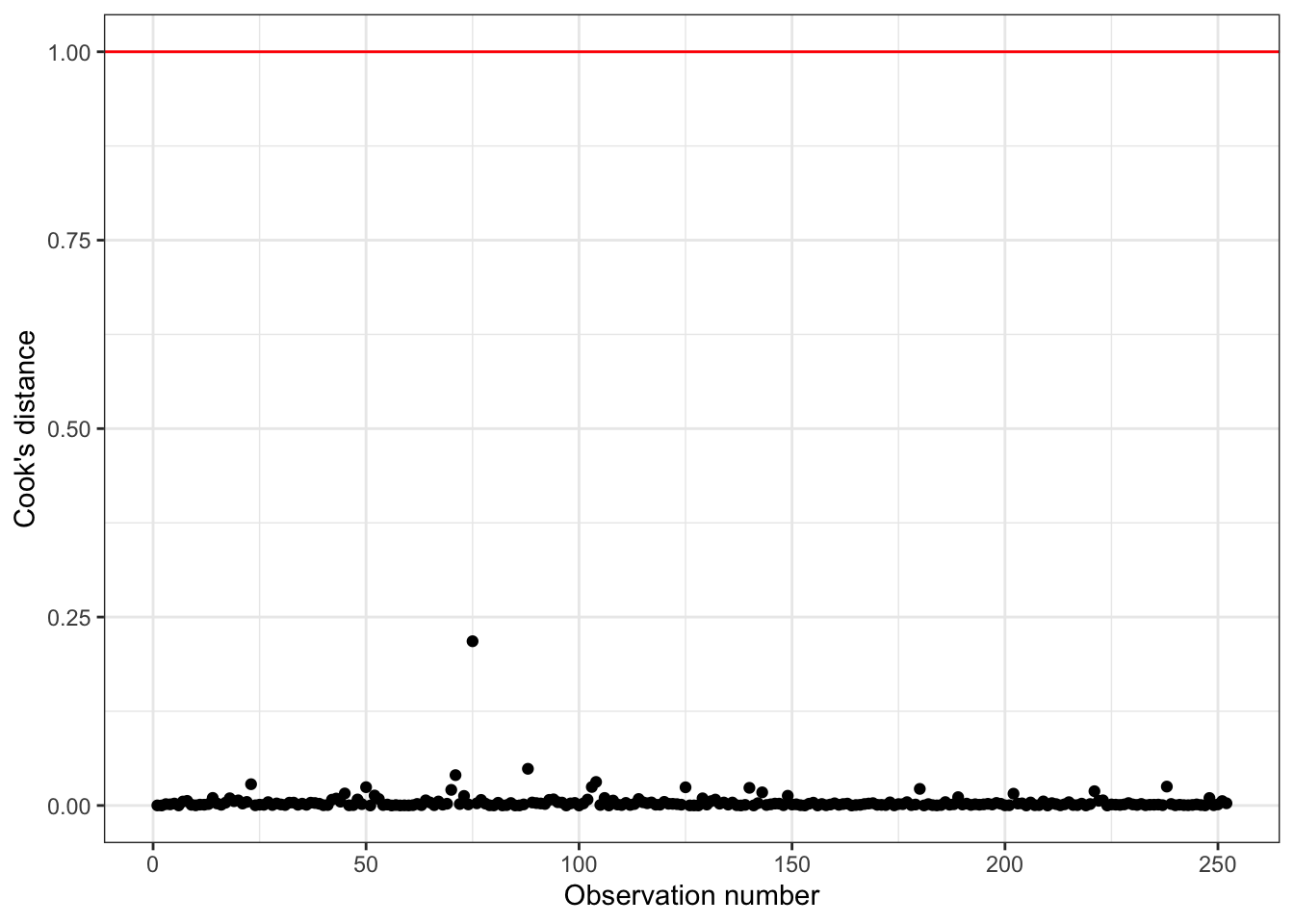
  • General thresholds .An observation with

    • \(D_i > 0.5\) is moderately influential

    • \(D_i > 1\) is very influential

Cook’s Distance

Cook’s Distance is in the column .cooksd in the output from the augment() function
Using these measures

  • Standardized residuals, leverage, and Cook’s Distance should all be examined together

  • Examine plots of the measures to identify observations that are outliers, high leverage, and may potentially impact the model.

What to do with outliers/influential points?

  • First consider if the outlier is a result of a data entry error.

  • If not, you may consider dropping an observation if it’s an outlier in the predictor variables if…

    • It is meaningful to drop the observation given the context of the problem

    • You intended to build a model on a smaller range of the predictor variables. Mention this in the write up of the results and be careful to avoid extrapolation when making predictions

What to do with outliers/influential points?

  • It is generally not good practice to drop observations that ar outliers in the value of the response variable

    • These are legitimate observations and should be in the model

    • You can try transformations or increasing the sample size by collecting more data

  • A general strategy when there are influential points is to fit the model with and without the influential points and compare the outcomes

Recap

  • Introduced model conditions for linear regression

  • Defined influential points

  • Introduced model diagnostics for linear regression

    • Leverage

    • Studentized residuals

    • Cook’s Distance

Next class

  • Exam 01 review

  • No prepare assignment