Logistic regression
Mar 17, 2026
Announcements
HW 03 due TODAY at 11:59pm
Project EDA due March 24 at 11:59pm (on GitHub)
Statistics experience due April 15
DataFest March 20 - 22: https://dukestatsci.github.io/datafest/
Mid-semester feedback
What’s helping your learning:
- Attending lecture
- Hands-on exercises
- Working through exercises individually and/or with others
What you want more of / want to keep doing to help your learning:
- Understand underlying concepts
- Review exercises during lectures/labs
- Options regarding group / individual work in labs
Topics
Logistic regression for binary response variable
Relationship between odds and probabilities
Odds ratios
Computational setup
Predicting categorical outcomes
Types of outcome variables
Quantitative outcome variable:
- Sales price of a house in Duke Forest
- Model: Expected sales price given the number of bedrooms, lot size, etc.
Categorical outcome variable:
Indicator of being high risk of getting coronary heart disease in the next 10 years
Model: Probability an adult is high risk of heart disease in the next 10 years given their age, total cholesterol, etc.
Do teenagers get 7+ hours of sleep?
Students in grades 9 - 12 were surveyed about health risk behaviors including whether they usually get 7 or more hours of sleep.
Sleep7
1: yes
0: no
# A tibble: 446 × 2
     Age Sleep7
   <int>  <int>
 1    16      1
 2    17      0
 3    18      0
 4    17      1
 5    15      0
 6    17      0
 7    17      1
 8    16      1
 9    16      1
10    18      0
# ℹ 436 more rows
Plot the data
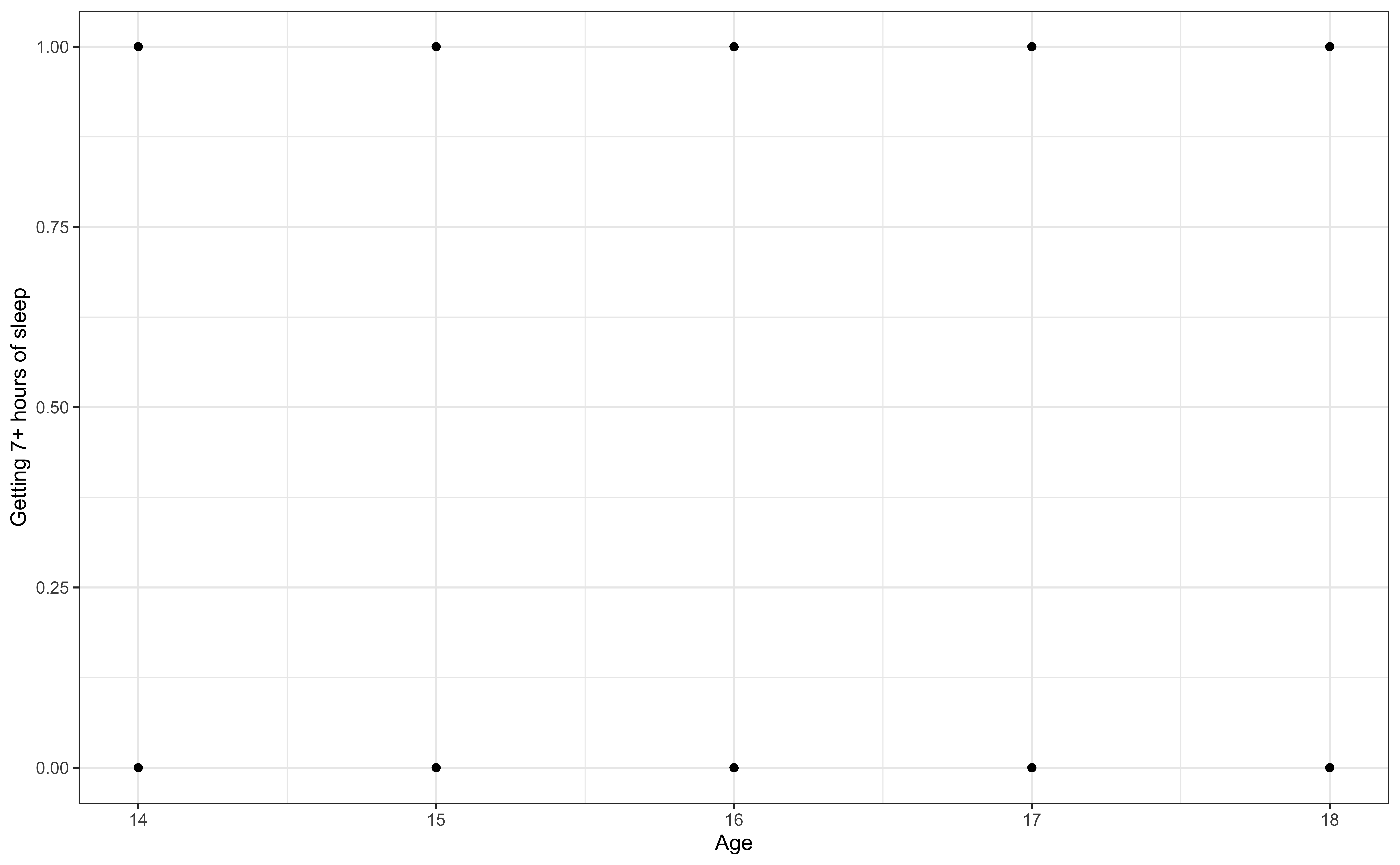
Let’s fit a linear regression model
Outcome: \(Y\) = 1: yes, 0: no
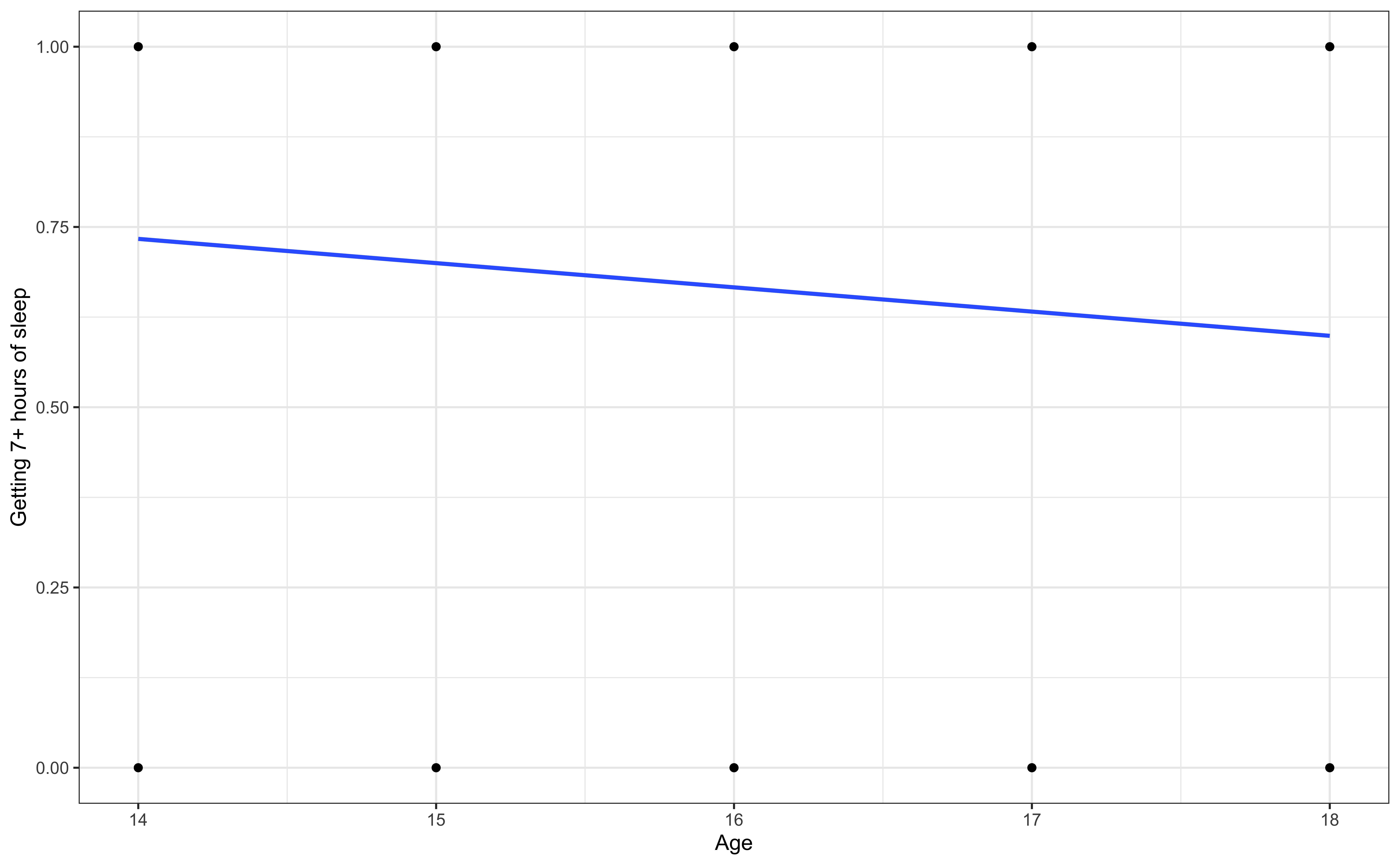
Let’s use proportions
Outcome: Probability of getting 7+ hours of sleep
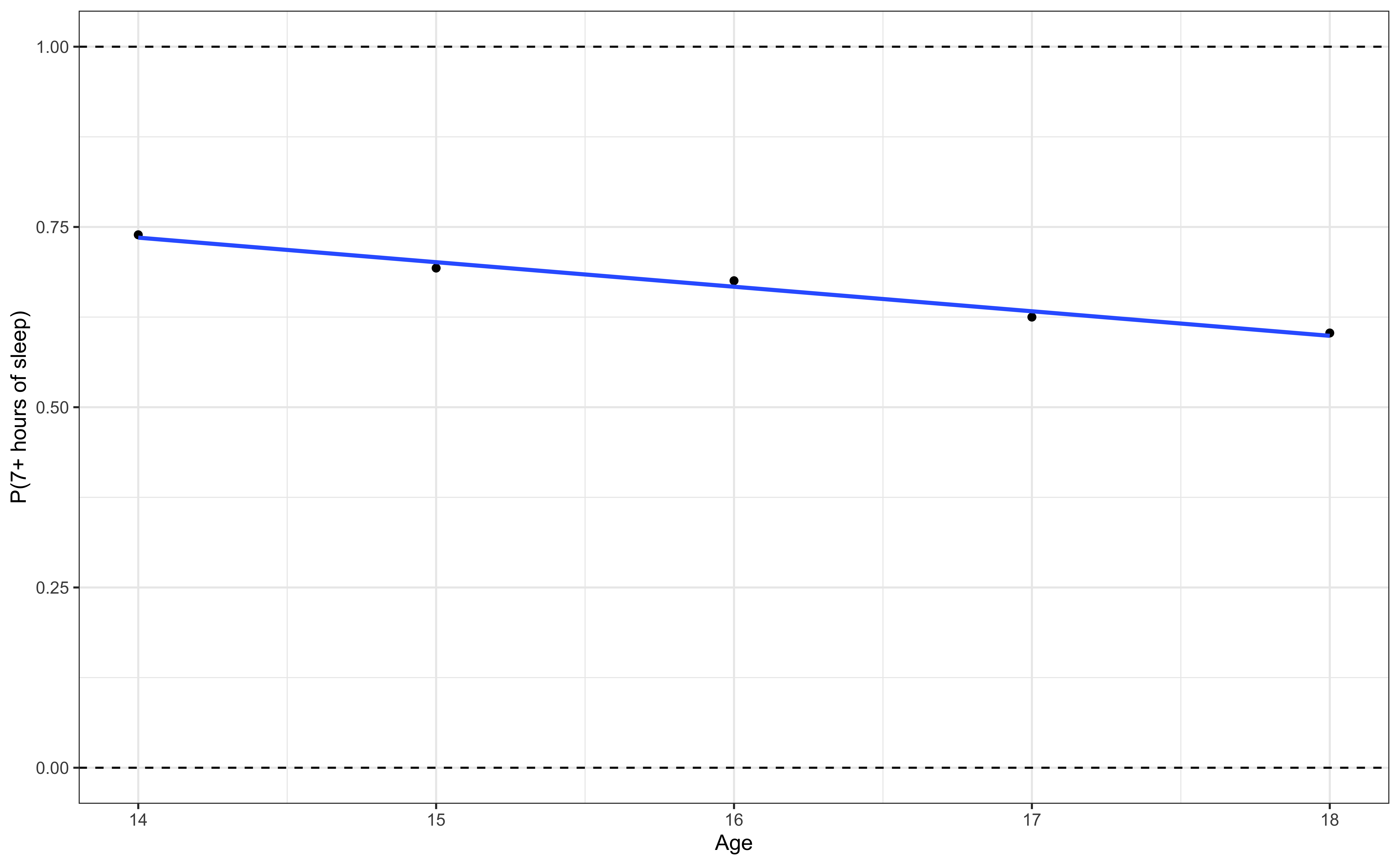
What happens if we zoom out?
Outcome: Probability of getting 7+ hours of sleep
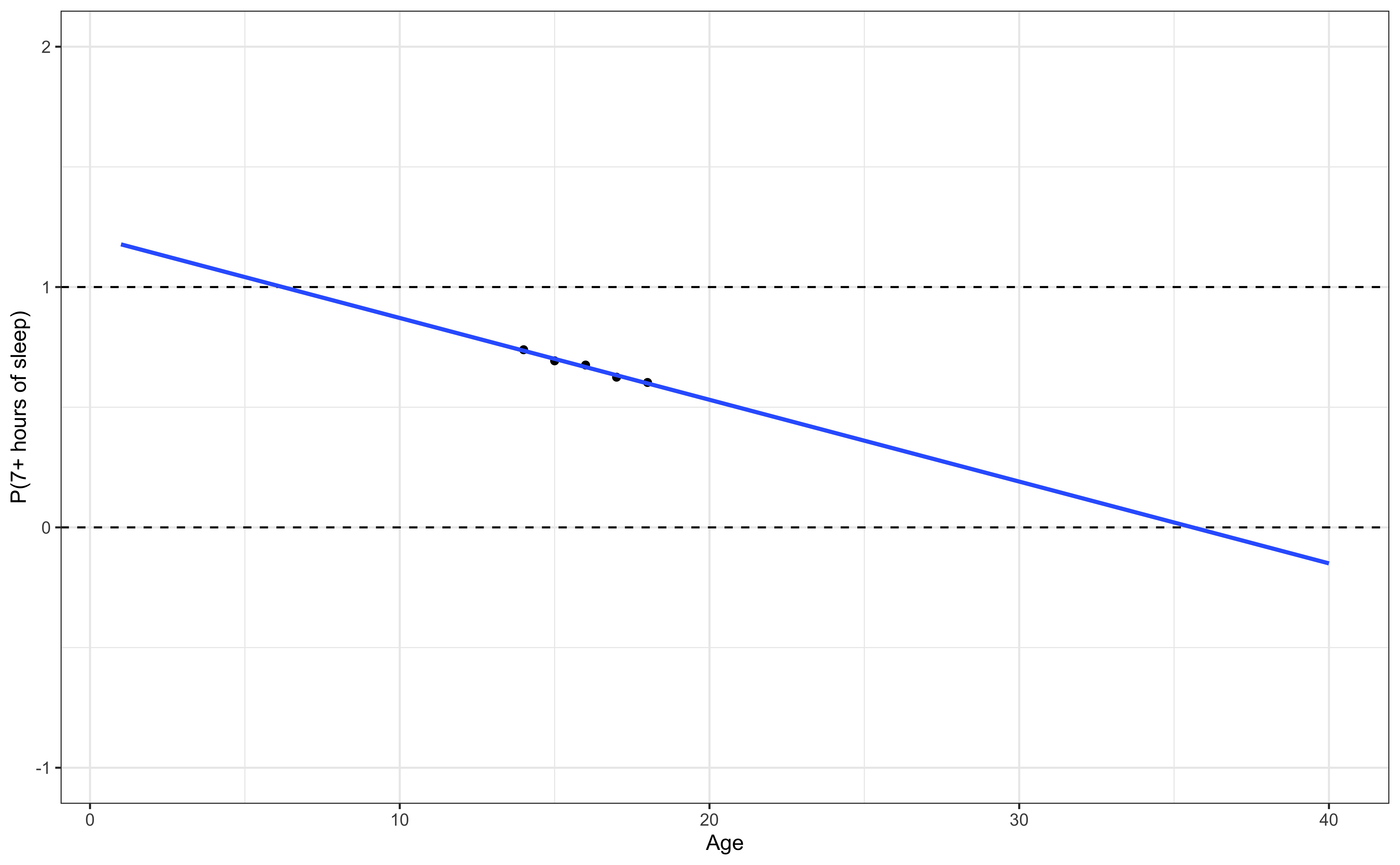
🛑 This model produces predictions outside of 0 and 1.
Let’s try another model
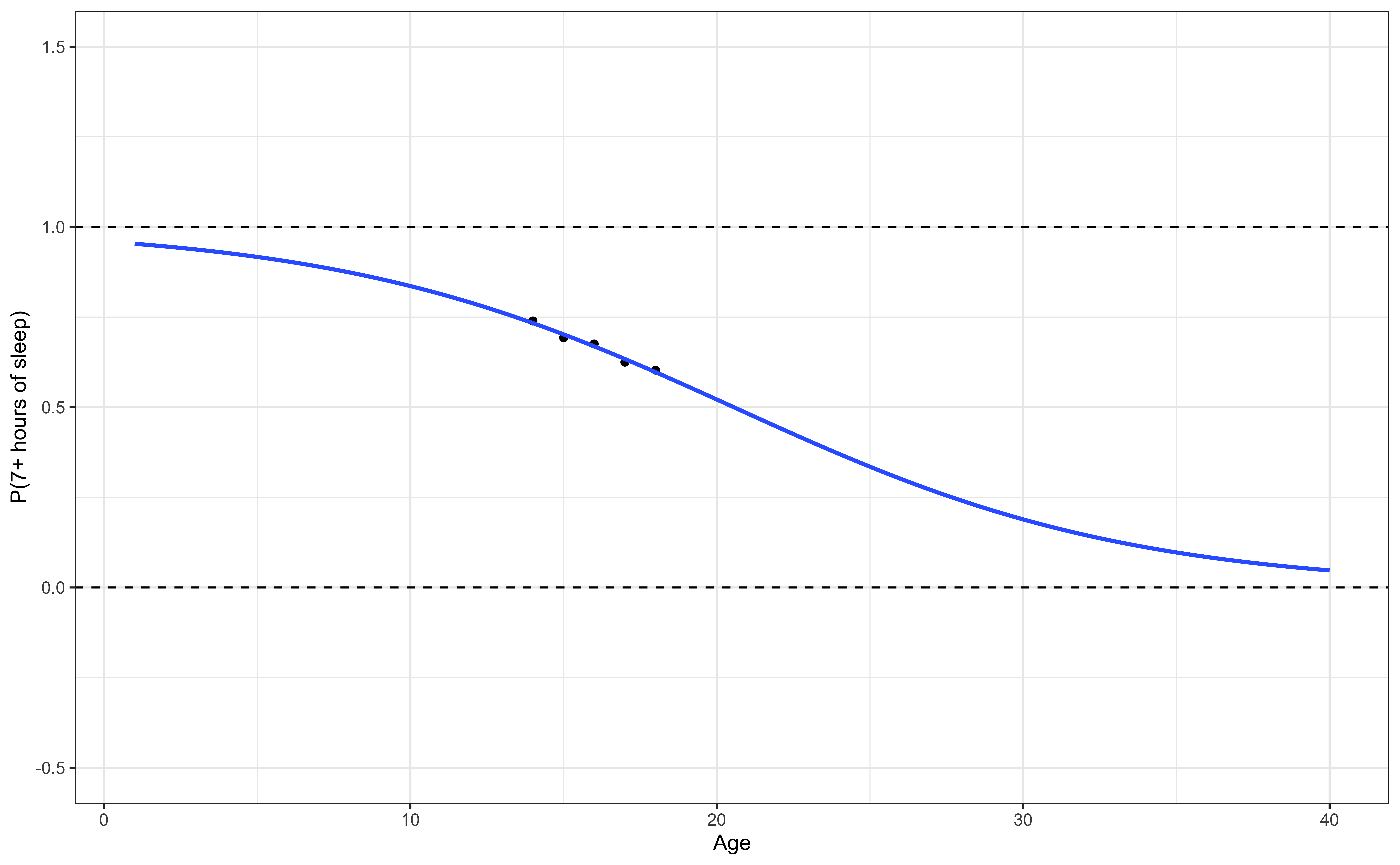
✅ This model (called a logistic regression model) only produces predictions between 0 and 1.
The code
Different types of models
| Method | Outcome | Model |
|---|---|---|
| Linear regression | Quantitative | \(y_i = \beta_0 + \beta_1~ x_i\) |
| Linear regression (transform Y) | Quantitative | \(\log(y_i) = \beta_0 + \beta_1~ x_i\) |
| Logistic regression | Binary | \(\log\big(\frac{p_i}{1-p_i}\big) = \beta_0 + \beta_1 ~ x_i\) |
Linear vs. logistic regression
State whether a linear regression model or logistic regression model is more appropriate for each scenario.
Use age and political party to predict if a randomly selected person will vote in the next election.
Use budget and run time (in minutes) to predict a movie’s total revenue.
Use age and sex to compute the probability a randomly selected adult will visit Duke Health in the next year.
Probabilities, odds, and odds ratios
Data: Concern about rising AI
This data comes from the 2023 Pew Research Center’s American Trends Panel. The survey aims to capture public opinion about a variety of topics including politics, religion, and technology, among others. We will use data from 11201 respondents in Wave 132 of the survey conducted July 31 - August 6, 2023.
The goal of this analysis is to understand the relationship between age and concern about the increased use of AI in daily life.
A more complete analysis on this topic can be found in the Pew Research Center article Growing public concern about the role of artificial intelligence in daily life by Alec Tyson and Emma Kikuchi.
Variables
ai_concern: Whether a respondent said they are “more concerned than excited” about in the increased use of AI in daily life (1: yes, 0: no)
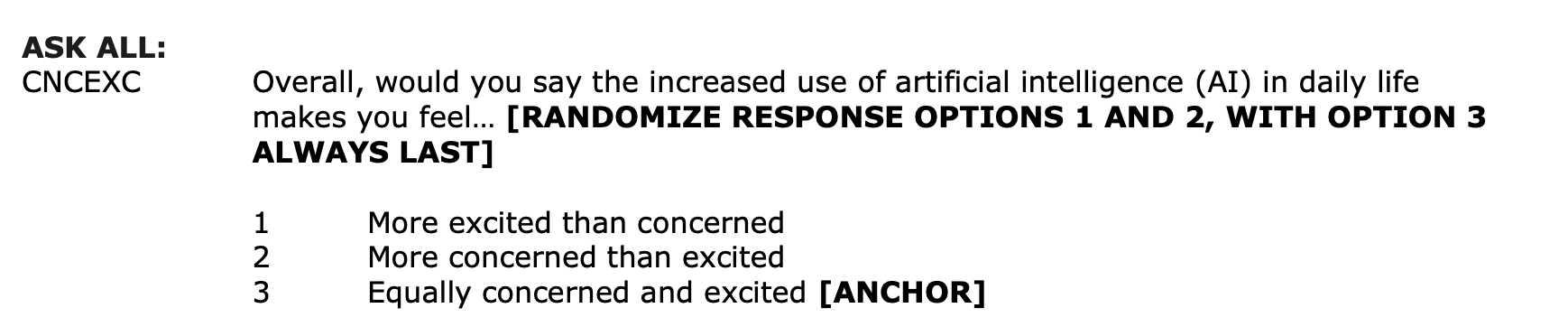
Source: Pew Research
Variables
age_cat: Age category- 18-29
- 30-49
- 50-64
- 65+
- Refused
Data prep
# change variable names and recode categories
pew_data <- pew_data |>
  mutate(ai_concern = if_else(CNCEXC_W132 == 2, 1, 0),
         age_cat = case_when(F_AGECAT == 1 ~ "18-29",
                             F_AGECAT == 2 ~ "30-49",
                             F_AGECAT == 3 ~ "50-64",
                             F_AGECAT == 4 ~ "65+",
                             TRUE ~ "Refused"
))

# Make factors and  relevel
pew_data <- pew_data |>
  mutate(ai_concern = factor(ai_concern),
         age_cat = factor(age_cat))
Univariate EDA
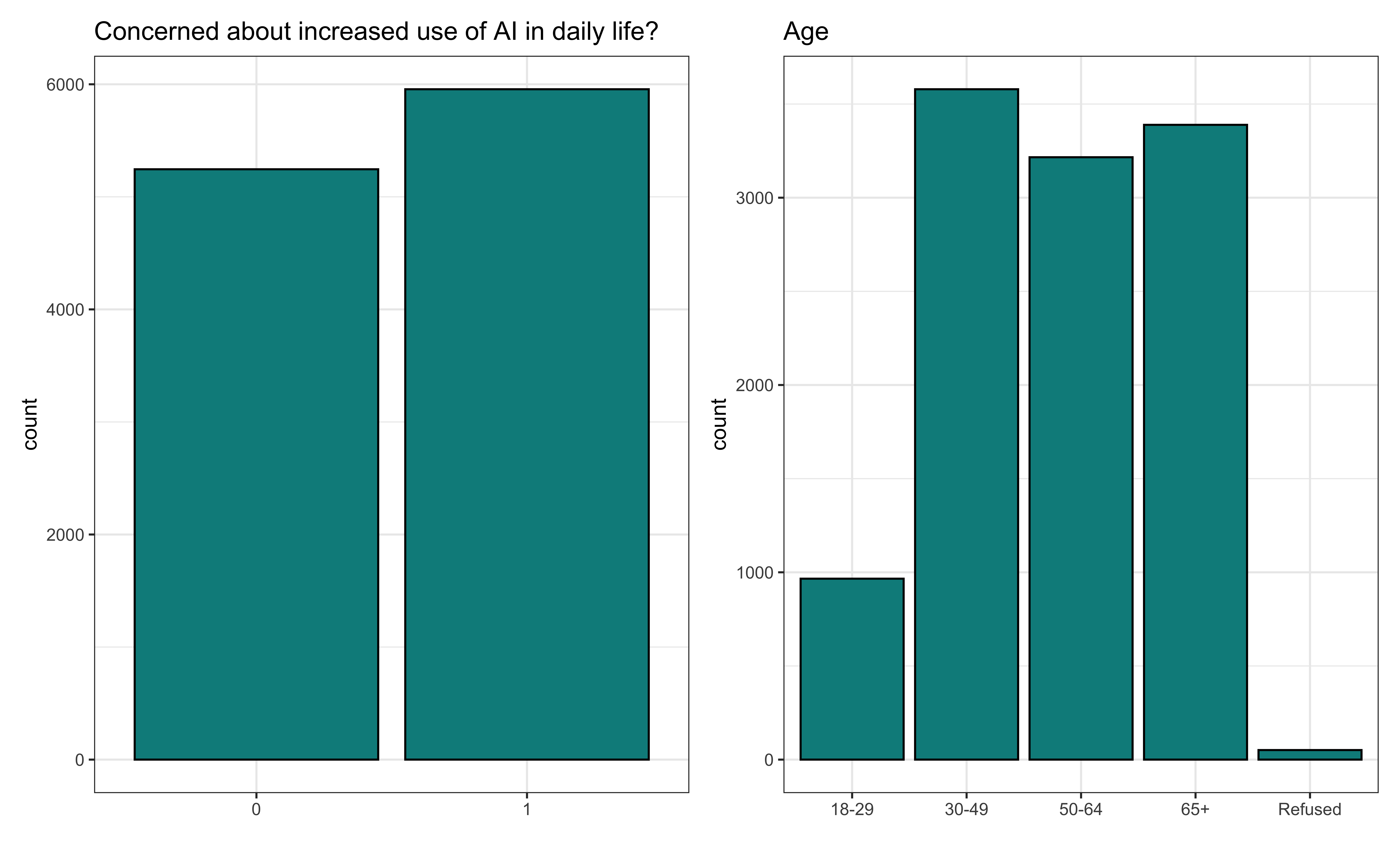
Binary response variable
\(Y = 1: \text{ yes (success), } 0: \text{ no (failure)}\)
\(p\): probability that \(Y=1\), i.e., \(P(Y = 1)\)
\(\frac{p}{1-p}\): odds that \(Y = 1\)
\(\log\big(\frac{p}{1-p}\big)\): log odds
Go from \(p\) to \(\log\big(\frac{p}{1-p}\big)\) using the logit transformation
Concerned about AI in daily life?
# A tibble: 2 × 3
  ai_concern     n     p
  <fct>      <int> <dbl>
1 0           5245 0.468
2 1           5956 0.532
\(P(\text{Concerned about AI}) = P(Y = 1) = p = 0.532\)
\(P(\text{Not concerned about AI}) = P(Y = 0) = 1 - p = 0.468\)
\(\text{Odds of being concerned about AI} = \frac{0.532}{0.468} = 1.137\)
From odds to probabilities
odds
\[\text{odds} = \frac{p}{1-p}\]
probability
\[p = \frac{\text{odds}}{1 + \text{odds}}\]
Odds ratios
Concern about AI vs. age
| Age | Not Concerned | Concerned |
|---|---|---|
| 18-29 | 550 | 416 |
| 30-49 | 1898 | 1681 |
| 50-64 | 1398 | 1818 |
| 65+ | 1376 | 2013 |
| Refused | 23 | 28 |
Compare the odds for two groups
| Age | Not Concerned | Concerned |
|---|---|---|
| 18-29 | 550 | 416 |
| 30-49 | 1898 | 1681 |
| 50-64 | 1398 | 1818 |
| 65+ | 1376 | 2013 |
| Refused | 23 | 28 |
We want to compare concern about increased use of AI in daily life between individuals who are 18-29 years old to those who are 65+ years old
Compare the odds for two groups
| Age | Not Concerned | Concerned |
|---|---|---|
| 18-29 | 550 | 416 |
| 30-49 | 1898 | 1681 |
| 50-64 | 1398 | 1818 |
| 65+ | 1376 | 2013 |
| Refused | 23 | 28 |
We’ll use the odds to compare the two groups
\[ \text{odds} = \frac{P(\text{success})}{P(\text{failure})} = \frac{\text{# of successes}}{\text{# of failures}} \]
Compare the odds for two groups
| Age | Not Concerned | Concerned |
|---|---|---|
| 18-29 | 550 | 416 |
| 30-49 | 1898 | 1681 |
| 50-64 | 1398 | 1818 |
| 65+ | 1376 | 2013 |
| Refused | 23 | 28 |
Odds of being concerned with increased use of AI in daily life for 18-29 year olds: \(\frac{416}{550} = 0.756\)
Odds of being concerned with increased use of AI in daily life for those who are 65+ years old: \(\frac{2013}{1376} = 1.463\)
Based on this, we see that individuals 65+ years old are more likely to be concerned about the increased use of AI in daily life than 18-29 year olds.
Odds ratio (OR)
| Age | Not Concerned | Concerned |
|---|---|---|
| 18-29 | 550 | 416 |
| 30-49 | 1898 | 1681 |
| 50-64 | 1398 | 1818 |
| 65+ | 1376 | 2013 |
| Refused | 23 | 28 |
Let’s summarize the relationship between the two groups. To do so, we’ll use the odds ratio (OR).
\[ OR = \frac{\text{odds}_1}{\text{odds}_2} \]
OR: AI concern by age
| Age | Not Concerned | Concerned |
|---|---|---|
| 18-29 | 550 | 416 |
| 30-49 | 1898 | 1681 |
| 50-64 | 1398 | 1818 |
| 65+ | 1376 | 2013 |
| Refused | 23 | 28 |
\[OR = \frac{\text{odds}_{18-29}}{\text{odds}_{65+}} = \frac{0.756}{1.463} = \mathbf{0.517}\]
The odds an 18-29 year old is concerned about increased use of AI in daily life are 0.517 times the odds a 65+ year old is concerned.
More natural interpretation
It’s more natural to interpret the odds ratio with a statement with the odds ratio greater than 1.
The odds a 65+ year old is concerned about increased use of AI in daily life are 1.934 (1/0.517) times the odds an 18-29 year old is concerned.
Code to make table
Code to make table
Code to make table
Code to make table
Logistic regression
Logistic regression model
Let \(\pi\) be the probability that \(Y = 1\). Then the population-level logistic regression model is of the form
\[ \log\big(\frac{\pi}{1-\pi}\big) = \beta_0 + \beta_1~X_1 + \beta_2X_2 + \dots + \beta_p X_p \]
where \(\log\big(\frac{\pi}{1-\pi}\big)\) = the log odds \(Y = 1\)
Why is there no error term in the population-level model?
Concerned about AI model
Fit logistic regression models using glm() with the argument family = "binomial".
| term | estimate | std.error | statistic | p.value |
|---|---|---|---|---|
| (Intercept) | -0.279 | 0.065 | -4.297 | 0.000 |
| age_cat30-49 | 0.158 | 0.073 | 2.159 | 0.031 |
| age_cat50-64 | 0.542 | 0.074 | 7.316 | 0.000 |
| age_cat65+ | 0.660 | 0.074 | 8.939 | 0.000 |
| age_catRefused | 0.476 | 0.289 | 1.648 | 0.099 |
Application exercise
From log odds to odds
| term | estimate | std.error | statistic | p.value |
|---|---|---|---|---|
| (Intercept) | -0.279 | 0.065 | -4.297 | 0.000 |
| age_cat30-49 | 0.158 | 0.073 | 2.159 | 0.031 |
| age_cat50-64 | 0.542 | 0.074 | 7.316 | 0.000 |
| age_cat65+ | 0.660 | 0.074 | 8.939 | 0.000 |
| age_catRefused | 0.476 | 0.289 | 1.648 | 0.099 |
How do we write this model in terms of the odds of being concerned about increase use of AI in daily life?
Interpret the coefficient of
50-64in terms of the odds of being concerned about increase use of AI in daily life.
Recap
Introduced logistic regression for binary response variable
Showed the relationship between odds and probabilities
Introduced odds ratios and interpretations in the logistic regression model